Could a first mover lock everyone out of outer space?
Citations
30th October 2026


Abstract
In this piece, we ask whether a first mover could prevent others from accessing outer space, or at least raise the cost of doing so. If this is possible, by force or otherwise, they would have a way to cement their lead.
We define two broad kinds of lock-out: soft and hard.
By soft lock-out, we mean capturing scarce, non-substitutable assets and denying them to rivals, which raises their cost of entry into the space industry. We think this could help a first mover entrench their early lead, making it more difficult for followers to catch up. In particular, the main strategies we consider are excluding rivals from orbital bands by occupying them with data centres or claiming the best sites on the Moon. We estimate a first mover could plausibly make a comparable presence in space ~$49–73B more expensive, a premium of roughly 5–7% on a ~$1 trillion build, which is small given the stakes. Soft lock-out falls far short of completely excluding later entrants from the space industry.
By hard lock-out, we mean using force to prevent followers from accessing space. The mechanism we focus on is space-based interceptors that destroy rockets as they launch from Earth. Using existing launch and hardware costs, we estimate a first mover could set up a system to attempt hard lock-out with interceptors for ~$150–390B (~$0.6–1.6T on a 20-year horizon) sized against today's fixed launch sites. These costs are accessible to the US, which is already pursuing a similarly capable system for missile defence (estimated at ~$1.2T over a 20-year horizon).
Rivals could respond by overwhelming the interceptors with rapid launches, destroying them with anti-satellite weapons, or threatening war on Earth. If they can maintain lock-out while supporting the development of a space industry into an industrial explosion, then they could eventually outgrow the world and achieve a decisive strategic advantage. Overall, we think there's a ~85% chance that space-side growth compounds into a big but recoverable lead for the first mover, with lock-out adding to it at the margin, and a ~5% chance that it enables a decisive strategic advantage.

Introduction
An intelligence explosion could trigger a wave of space activity, largely through autonomous operations and robotics. This motivated our concern that first movers who can make productive use of space resources may be able to seize control of the long-term future. In particular, we are interested in whether an early lead in space could confer a decisive strategic advantage (DSA): an advantage sufficient to achieve complete domination over everyone else without facing effective opposition.
This is a very high bar. The balance of power in space could just reflect the existing balance of power on Earth. Indeed, we would call this the baseline case: that space is strategically important but does not offer anyone a decisive strategic advantage because early space activity1 is dominated by pre-existing terrestrial power asymmetries. However, in this piece, we investigate new technological developments and military strategies that could move us off this baseline.
We focus on lock-out: a first mover, or leader, securing access to space while denying it to rivals. Launch from Earth is the chokepoint that would make this possible, and a leader that held it would have exclusive access to practically unlimited resources. This piece asks whether such a lock-out is possible, by force or otherwise, and whether it would be decisive. There are other plausible pathways to a DSA through space expansion, but we focus on lock-out because we think it is the most concrete and concerning.2
In the conclusion we distinguish three cases: the baseline case above; a serious case, in which space-side growth compounds and lock-out adds to a lead that a well-resourced follower could still recover; and a decisive case, in which hard lock-out confers a DSA. We end up placing ~10% of our probability in the baseline case, ~85% in the serious case and ~5% in the decisive case.
What is lock-out?
As long as industrial civilisation continues to grow, the space industry will eventually outgrow industry on Earth. Earth industries will reach ceilings on growth (e.g. due to warming from industrial waste heat3), and space may unlock physics asymmetries that enable faster growth before industry on Earth hits growth ceilings (for example, there is ~5–7× more usable solar energy per square metre in certain Earth orbits compared to Earth's surface4). If a first mover can expand to space and prevent others from doing the same, they will have effectively locked out rivals from a region whose practically unlimited energy and material resources could eventually confer a DSA.
We previously investigated the ability of a first mover in space to deliberately disperse debris throughout Earth orbit to make space inaccessible to everyone else, and found the strategy to be ineffective.5 In this piece, we expand on the concept of lock-out to investigate a range of strategies that would make it harder for rivals to also make productive use of space.
We divide lock-out into two broad categories:
- Soft lock-out: raising the cost for competitors to enter the space industry, without the use or threat of force, most notably through capturing scarce, non-substitutable assets (orbits, spectrum, lunar sites) before rivals can.
- Hard lock-out: using force to prevent others from expanding to space. We focus on the use of space-based interceptors to destroy rockets as they launch from Earth.
A competitor is locked out when they have no viable path to gain a foothold in the space industry. The soft lock-out section tests whether soft strategies can stack workaround costs beyond what any later entrant could mobilise.6 Under hard lock-out, later entrants would be unable to overcome the physical force preventing access to space.
In practice, “lock-out” means selective denial: the leader exempts itself and allies, and denies rivals.
Throughout, we condition on broadly present-day space governance, like licensing under the ITU and FCC, no auctions of orbital slots or similar allocation mechanisms, and no new international enforcement mechanisms. This shows how far a first mover could get if nothing changes, and in the conclusion, we return to the rules that could be changed to keep the future open.

Soft lock-out
Imagine you set out to build an industrial presence in a new land, but your competitor has already built the ports and railways in the most advantageous locations, has exclusive access to the best woodlands, mines, and suppliers, and owns and operates the power lines and roads. If they wanted, your competitor could effectively block you from building up your own industrial capacity by refusing to sell or lease their existing assets. A strong first mover in space could take advantage of dynamics like these to lock out competitors for strategic reasons, raising the cost of every foothold in the space industry. In this section we investigate what we think are the best candidates for soft lock-out: sun-synchronous orbits and the best lunar sites.7 We also discuss why we think that completely locking out any foothold in the space industry without using force or breaking laws is not possible.
Overall, we find that soft lock-out mechanisms can provide a modest advantage to a first mover by raising costs for later entrants. Later entrants could pay tens of billions of dollars in workaround costs. On its own, soft lock-out is very unlikely to be decisive. However, in the tail case where orbital data centres become the marginal source of compute during an intelligence explosion, a first mover holding the best orbits (most plausibly SpaceX) could turn that position into a lasting lead in compute and AI capabilities. More importantly for this paper, a soft grab also supplies revenue and an infrastructure base from which a first mover can expand into hard lock-out.
Mechanisms
The mechanisms for a first mover to pursue soft lock-out in space include:
- Monopolising scarce locations or resources: claiming the best orbital and lunar real estate before rivals can, leaving them with worse positions, e.g. grabbing the dawn–dusk (terminator) planes of the sun-synchronous shell (below).
- Shaping rules and institutions: shaping licensing, spacing, and safety rules so they favour first movers over later entrants,8 or raise the regulatory floor in a way that burdens new entrants. For example, ITU/FCC first-come coordination priority, or Artemis “safety zones” on the Moon (covered below). This second mechanism works with the first. If licensing practice hardens in incumbents' favour, whoever files first, launches more often than rivals can, and holds the planes, could turn that hold into lasting exclusion.9
Note that neither of these strategies necessarily involves using hard force or breaking well-established national or international law. The activities that enable these mechanisms are already being pursued by leading nations and companies in the space domain.
A natural economic objection to soft lock-out is that a commercial incumbent should prefer renting a scarce asset to excluding rivals from it, since both sides gain from the trade. But lock-out in our sense is strategic: the asset's value to the first mover includes the rival's exclusion, so a mutually agreeable price would be much more difficult to find.
First movers can also gain leverage by building infrastructure rivals come to depend on and then selectively denying it — a distinct strategy we set aside here.10 We focus purely on strategies that raise absolute costs for later entrants.
Soft lock-out in practice
For each of the two candidate assets, the terminator planes of the sun-synchronous shell and the prime lunar sites, we quantify the workaround cost: what a later entrant must pay, in US dollars, to obtain the same advantage by other means.
The dawn-dusk (terminator) planes of the sun-synchronous orbital shell allow near-continuous line of sight with the Sun.11 This raises the fraction of the time during which solar panels generate energy (the capacity factor) from ~63% (for a generic, non-sun-synchronous low-Earth orbit) to ~95%+. Orbital data centres (ODCs) may be placed here to take advantage of the high energy availability. SpaceX has already asked the FCC to license ~1 million data-centre satellites at sun-synchronous and 30° inclinations (Appendix 1). In the extreme, and if licensing practice hardens in incumbents' favour, an actor could occupy the vast majority of these orbits and shut out later entrants, either through licensing priority and the coordination burden an incumbent imposes on them12 or by overcrowding the orbits until placing more satellites there becomes impractical.13 We estimate that SpaceX, who dominate launch cadence, could occupy the sun-synchronous shell densely enough to lock out later entrants within 3–5 years of reaching a Starship cadence of 17–30 launches per day14 (at an optimistic ~5t per satellite; heavier satellites push the requirement to ~35–90 per day, beyond even Musk's stated goal of a launch an hour, and the fill past the 3–5 year window; Appendix 1). Building on the terminator planes costs ~$35.0B per GW over five years by our models. A follower shut out of them would probably do best to build on Earth, at ~$36.8B per GW, so the workaround cost they pay is at most the orbit-versus-Earth gap: ~$1.8B per GW (+5.1%).15,16 Only a slice of the shell is worth locking everyone else out of: the 16 of its 72 orbital paths closest to the terminator, where panels are lit ≥93% of the year (slightly wider than the ~95% core; Appendix 1), which hold ~27–33 GW of computing power at the filing's density.17 At ~$1.8B per GW, a follower shut out of them pays ~$47–59B in total (on a ~$1 trillion build of that capacity). That premium exists at all only if orbital data centres beat terrestrial builds on cost, which our earlier analysis rates as plausible but not assured. So, overall, a first mover grabbing the best orbits for ODCs is not likely to prevent other actors from also building ODCs.
There are also scarce assets that can be grabbed on the Moon, raising costs for later entrants. The most valuable assets are at the Moon's poles, including water ice in permanently shadowed regions, near-permanent power on peaks of eternal light (lit 80–95% of the year), and flat ground for landing pads or constructing mass drivers. The water ice is most valuable for producing liquid oxygen propellant. Of 130 candidate landing sites, just three dominate the accessible water ice tonnage, together holding up to ~1,200 tonnes of water ice18 (about half of the modelled total, itself an upper bound). A first mover can potentially lock out rivals through the Artemis Accords “safety zones”: the Outer Space Treaty bars appropriation, but a safety zone can act as a de facto exclusion zone around active operations, leaving rivals the worse sites.19 However, a locked-out actor has many cheap workarounds: importing water (and other volatiles), lofting solar arrays on masts to expand access to peaks of eternal light, or building up sub-structures for landing pads or mass drivers. Grabbing the best sites in the south polar region therefore imposes a workaround cost of only ~$1.4–14B at plausible post-Starship delivery prices (Appendix 2). For comparison, NASA's Inspector General projected in 2021 that Artemis spend through FY2025 would reach ~$93B.
These examples price single assets in isolation. Summing the above premiums creates an upper-end workaround cost to later entrants of ~$49–73B. These costs would raise the price of entry but come nowhere near removing a viable path to a foothold: any entrant backed by a major spacefaring nation could probably absorb them. For scale, US annual defence spending is ~$954B, and SpaceX's capital expenditure in 2025 was ~$20.7B.20 The head start would matter more in the compute tail case flagged above (see “When is lock-out decisive?”).
What would it take to leave later entrants no viable path at all? If a first mover were to buy every purchasable space asset (spectrum licences, orbital planes, etc.), it would cost them ~$1–2 trillion, of which the terminator-plane data-centre constellation is about $0.95–1.2 trillion, plus ~$150–250B a year to replace hardware with a five-to-seven-year life. Even then, later entrants could still build their own rockets and industrial bases elsewhere, so buying everything21 would still just impose the ~$49–73B premium above. Under present-day space law and policy, it does not seem possible for one actor to purchase everything to deny anyone else a foothold in the space industry. If, for example, the rules changed so that there was a cap on orbital capacity grandfathered to incumbents, then soft lock-out could be more extreme. However, the FCC has so far declined to adopt a rule like that.22
Historically, on Earth, followers have caught up despite soft lock-out and the compounding growth it gave incumbents, even in extreme cases. The US transcontinental railroads are a good example. In the 1850s, Congress's Pacific Railroad surveys examined only ~5 candidate corridors to the Pacific, so first movers could grab these corridors and later entrants would have to route around at a premium. The railroads also enjoyed compounding growth: subsidies and land were granted per mile of track to the Union Pacific and Central Pacific, so building track funded more track. Yet competing transcontinentals closed the growth lead within decades through market competition alone. Some residual lock-outs had to be unwound by government intervention: the Terminal Railroad Association of St. Louis (TRRA) came to own every rail bridge and the terminals at St. Louis, and refused access to rivals. Competitors built a new bridge as a workaround (the Merchants' Bridge), but then the incumbents just bought it. Eventually, the Supreme Court (1912) forced the TRRA to allow competing railroads access on equal terms as they were in violation of the Sherman Antitrust Act (1890). For anyone worried about soft lock-out in space, this is good news: national interventions can undo even extreme cases of lock-out by industry actors. However, the railroads example occurred within a nation state, whereas space is shared by the international community. The lock-out could be conducted by a nation state itself,23 and international law is unlikely to have the enforcement power to unwind a strong first-mover advantage. We think that the US is particularly well-positioned to conduct soft lock-out.
The activities that enable these soft lock-out mechanisms (e.g. SpaceX's million-satellite filing and the Artemis Accords' safety-zone provisions) are already underway, need not involve investment in defensive capabilities or breaking established law, and are not acts of war, but could impose a ~$49–73B premium on top of baseline entry costs. However, this is not insurmountable for later entrants.24 Britain's Industrial Revolution is a second precedent for followers catching up: despite Britain's attempt at soft lock-out (banning the export of textile machinery and the emigration of the mechanics who could build it),25 Germany and the US closed Britain's lead within about half a century.
Soft lock-out could matter as a pathway to more decisive capabilities: bootstrapping a space industry that achieves faster doubling times than Earth and outgrows the world, gaining powerful weapons through dual-use infrastructure (like mass drivers), or expanding into hard lock-out. The rest of this piece follows the last of these, which we believe is the most concerning case, and plausibly preventable now through space law and policy interventions (we list candidates in the conclusion).

Hard lock-out
Hard lock-out is a mechanism by which a first mover in space can achieve a durable and defendable monopoly on access to space through the use of force. In this section, we assess the feasibility of hard lock-out. We argue that kinetic interceptors in Earth orbit are a technically credible pathway to block off access to outer space. The interceptors would cost ~$150–390B to comprehensively lock out other actors based on current hardware and launch costs. We cover the background and calculations in more depth in Appendix 3.
Launch is the chokepoint for space expansion
For a first mover to effectively deny everyone else access to space, there must be a chokepoint a rival cannot route around. Space is big and resources are widely distributed, so once spacecraft are operating in deep space, there is no clear chokepoint.26
The most plausible chokepoint for a hard lock-out is launch from Earth, because:
- Every Earth-bound actor has to climb out of Earth's gravity well to initially access space.
- Launches currently leave from a few dozen fixed, surveyed spaceports, a handful of which carry most of the traffic.27
- An ascending rocket is fragile, bright, and slow during its boost phase.
- Rockets have almost no ability to evade attacks during the boost phase.
Actors could use various weapons to intercept rockets or attack space assets; we cover those weapons in Appendix 3 However, in this section we focus on kinetic interceptors, which we believe are both potent and near-term-feasible. They would destroy rockets during their boost phase or intercept assets already in space. Space-based directed-energy weapons are the most plausible alternative pathway (but not as near-term). We do not assess them here beyond a brief sketch in Appendix 3 If lasers turned out to be cheaper or more effective, hard lock-out would be more feasible than we estimate.
If an actor achieves space industrial closure — they are manufacturing everything they need in space and no longer need to launch anything from Earth to continue growing — then launch from Earth would no longer be a decisive chokepoint. However, we think it very unlikely that an actor could achieve space industrial closure before any other actor gains the ability to lock out rivals.28
Hard lock-out in practice
Whoever is leading the world in launch cadence and has the funding to develop the technology for kinetic interceptors can attempt hard lock-out.29 The Congressional Budget Office (CBO) estimates that space-based interceptors would cost ~$22M each,30 and they would most likely be placed in low-Earth orbits. Once global coverage is achieved — at least one interceptor in range of every launch pad on Earth at all times — the system could be oversized to guard against adversaries overwhelming it with many launches from one location. We work through all these considerations in Appendix 3.
Here are our two mainline cost estimates for a kinetic interceptor system for hard lock-out:
- Minimal system: For a system of kinetic interceptors that cover the entire Earth so that every launch pad is in range at any given moment, ~480–720 interceptors would be needed at a total cost of ~$10–16B (at the CBO's programme-average unit cost; a first small production lot would cost more per unit). This would cover single launches from any launch pad in the world, but if a rival launched multiple rockets from one spaceport simultaneously, some rockets could break through. Additionally, firing many direct-ascent anti-satellite weapons at once could saturate the system and destroy interceptor platforms easily. Rivals could also threaten to detonate a nuclear weapon in orbit or deliberately initiate Kessler syndrome.
- Comprehensive system: For a system of kinetic interceptors that we estimate would be comprehensive against today's fixed launch pads, ~7,000–18,000 interceptors would be needed for a total cost of ~$150–390B. This would involve multiple layers of kinetic interceptors staged across various altitudes to compensate for weaknesses of lower-altitude assets, and to attack and destroy any rockets that make it through lower layers. It is also 13–24× oversized relative to the baseline layer to deal with decoy rockets and coincident salvos from multiple pads.
$150–390B is our main estimate for a system capable of locking out access to space. The details are in Appendix 3, but here's the overview of how we got this number: (1) We made a model to ensure one interceptor is in range of anywhere on Earth: N₁ = 4k(R⊕ + h_int)²/r_f², with k = 1.6, R⊕ + h_int = 6,521 km and a footprint radius r_f = 620–760 km, gives N₁ ≈ 480–720. (2) Waiting 60 seconds to observe and identify decoy rockets reduces the footprint of the interceptors, needing 1.7–2.0× more interceptors for global coverage. (3) We then oversized the system to deal with 8–12 rockets launching at once, so the low-Earth orbit layer is 480–720 × (1.7–2.0) × (8–12) ≈ 6,300–16,900 interceptors.31 (4) We added a layer at a higher orbit to destroy space assets that leak through (MEO; ~140–240 interceptors on ~24 platforms), and a forward layer in very low-Earth orbit for rapid kills (~440–640 interceptors) giving ~7,000–18,000 interceptors in total. (5) At the CBO's $22M interceptor cost, the low-orbit layer is $140–370B and the other layers $14–23B: ~$150–390B in hardware (five-year service life makes the 20-year cost ~$0.6–1.6T). Since this is just the hardware launched to space, and doesn't include staffing, logistics, accidents or any other costs, this number could be reasonably doubled to $300–780B.
The comprehensive coverage is affordable for a powerful nation state. The US is already building the Golden Dome: a missile defence system using kinetic interceptors for global coverage. The CBO estimates a cost of $1.2T for Golden Dome over a 20-year period, which would include ~7,800 interceptors.32 For our lock-out architecture, the 20-year cost (including replacement of interceptors) would be ~$0.6–1.6T, straddling their ~$720–743B space-based interceptor estimate.33 Per vehicle intercepted, launch denial is easier than defending against fast-burn solid ICBMs, which spend under three minutes in boost. However, we oversize for a rival firing 8–12 rockets at once while the CBO assumes 10 near-simultaneous ICBMs engaged twice over, so the cost estimates end up being quite similar. Importantly, though, any constellation able to hit a missile in boost phase could in principle also hit a rocket in boost phase. This is a property of boost-phase intercept as such, but it means that the marginal cost of hard lock-out capability is small at the favourable end of our range.34
To field the comprehensive kinetic interceptor system would take as few as ~20 launches by mass at the favourable end and ~65 at the conservative end — more realistically ~50–100 launches once orbital planes are accounted for35 (this is very little when compared to the 17–30 launches per day for 3–5 years for the soft lock-out of sun-synchronous orbits with ODCs). As a result, by stockpiling interceptors, the whole interceptor system could be fielded quickly, plausibly over a period of weeks to a few months once Starship is operational. However, manufacturing ~7,000–18,000 interceptors would be a multi-year and likely observable industrial effort (the US awarded its first space-based interceptor prototypes in November 2025).
Can rivals break the lock-out?
Whether hard lock-out can be sustained could depend on a cost exchange. If defending space assets that deny launch is cheaper than attacking them, then the leader can afford to maintain hard lock-out against attack. When space assets are not easily defensible, rivals can cheaply contest any foothold in space by force, and lock-out seems less feasible.
A rival being locked out has various responses available (using present-day technology), and each changes the relative costs of denying access to space. To overcome hard lock-out, rivals could defeat the system directly (e.g. by attacking the interceptors with anti-satellite (ASAT) weapons), deny space benefits to everyone (e.g. by detonating a nuclear bomb in orbit), or attack the leader on Earth (e.g. by bombing spaceports):
- Defeat the system directly. Rivals could overload the system (e.g. with decoys) or destroy the interceptors (e.g. with ASAT weapons). Each direct-ascent ASAT costs more than the interceptor it kills (~$28M against ~$22M), so attrition trades at roughly 1.3× in the leader's favour (at current cost). Cheap decoy boosters trade ~3–5× in the rival's favour against the interceptors per shot, though the leader can counter by delaying intercepts until decoys reveal themselves, at the cost of a ~1.7–2× larger constellation. Overall, attacking the interceptors directly with ASATs is unlikely to win a war of attrition. Decoys and extra launch pads trade in the rival's favour, but they raise the leader's costs without clearing the layer, so the question becomes whether the leader is willing to keep paying (see the end of this section). We work through this in more detail in Appendix 3.
- Deny space benefits to everyone. A rival locked out from space could threaten to deny the benefits of space to everyone by initiating Kessler syndrome or detonating a nuclear bomb in orbit. A high-altitude nuclear burst of 110 kt or more could promptly jeopardise ~20% of low-orbit satellites, and the artificial radiation belt it pumps could disable the vast majority of unhardened satellites in low-Earth orbit within a few weeks to months. This is a levelling attack: launches can continue through the elevated radiation, but satellites that stay in the affected bands would be degraded.36 Most of the leader's interceptors (~400 km) and orbital data centres (500–1,000 km) would be low enough to be affected by these bands. However, the rival would have less at stake. It would also be extremely challenging to intercept a warhead sent to detonate in orbit. A warhead can reach 400 km on a suborbital lofted trajectory with a 60–180 s boost (too quick to reliably intercept), so the leader would have to rely on deterrence. If deterrence fails and assets in low-Earth orbit are destroyed, lock-out could still persist. The leader's untouched launch base lets it re-field the interceptor layer first as the belt decays,37 and they would still have interceptors staged at higher orbits to deny rivals the ability to place satellites in these orbits. This holds only if the rival stops at one detonation: re-pumping the belt with further bursts would cost a small fraction of the layer. The upshot is that the leader cannot stop this attack, only deter it; if deterrence fails, it loses its low-orbit assets but keeps its launch base and the higher layer, so lock-out survives in a degraded form for as long as the rival does not keep re-pumping the belt.
- Attack the leader on Earth. In an extreme scenario, a locked-out actor could also escalate the conflict and use missiles to strike the leader's spaceports (or other essential terrestrial infrastructure like ground stations), locking everyone out of space (a 'spoiling' or 'sabotaging' attack). Generally, this only delays lock-out, potentially giving the rival the opportunity to catch up on launch capacity. Interceptors could destroy ballistic missiles attacking the leader's homeland. However, they may not be very effective in protecting coastal spaceports against attacks like sea-launched cruise missiles, depressed-trajectory submarine launches, hypersonic glide vehicles, or sabotage.38 A leader might also be tempted to strike a rival's launch infrastructure before the rival could respond, which would also reduce the coincident-salvo threat the interceptor layer must be sized for. That would be a first strike on another state's territory. If the spaceports fall, the leader would keep the orbital layer and can still deny new launches, but loses its ability to replace interceptors, and the layer decays over its ~5-year service life. The race then depends on whether the leader can rebuild its launch capacity before its interceptors expire: likely, but not certainly, it could. If both actors are able to continually deny rocket launches, then the other plausible end state of this exchange is mutually assured denial: both sides are able to deny each other access to space.
Overall, maintaining an asymmetric cost of denial in favour of the leader is messy and requires constant adaptation, as in any conflict. Against a state without nuclear weapons or a large missile force, the interceptors themselves would be hard to defeat; the constraints on such a use would be political and legal rather than technical. Between two superpowers, hard lock-out seems much harder for one nation to maintain: the peer's cheapest responses (a nuclear detonation in orbit, strikes on spaceports) cannot be affordably intercepted by the interceptors and likely result in escalation to war. Against a peer willing to burn the commons, hard lock-out therefore rides on nuclear deterrence holding while the leader absorbs the loss of its low-orbit economy. In other words, against a nuclear peer the interceptors do not decide the contest: whether the peer uses these levellers is a deterrence question, which we do not model, so this conclusion is less robust than the cost estimates above. The benefits of lock-out39 could still justify absorbing the unfavourable marginal exchanges a lesser rival can force (e.g. cheap decoy boosters), so the rival cannot simply drain the leader's economy.

When is lock-out decisive?
Even if an actor could field a comprehensive weapon system to deny access to outer space, that alone would not be decisive. In the context of a coming intelligence explosion, lock-out can confer a decisive strategic advantage when two further conditions are met:
- The kinetic interceptors remain effective despite advances in AI-driven cyber capabilities, wider technological change, or shifts in the terrestrial balance of power.
- The actor (or coalition) locking out everyone else can maintain its own Earth-based territory and supply chains to support the development of a space industry that eventually outgrows the world.
We cover both in turn and then give our overall judgement: we put the probability of decisive lock-out through kinetic interceptors at ~5%.
Keeping the kinetic interceptors effective through the intelligence explosion
Lock-out requires continual maintenance and resupply, such as replacing interceptors that have empty propellant tanks or degraded electronics. Starlink satellites, for example, are replaced roughly every 5 years. The CBO's Golden Dome costing likewise assumes a five-year service life for its space-based interceptors.40 Assuming the interceptors have a similar lifetime, replacing a comprehensive interceptor layer would cost ~$30–78B per year (~3–8% of the current US defence budget). This seems affordable and an unlikely bottleneck, so long as the interceptors remain strategically valuable for lock-out (and nuclear deterrence).
However, we might experience an intelligence explosion soon, and the kinetic interceptors would have to maintain their advantage throughout that period. The rate of technological progress during an intelligence explosion may be so great as to rapidly render the kinetic interceptors obsolete. Such progress may unlock cheaper ways to expand to space, allowing the system to be overwhelmed. Alternatively, much cheaper counterspace weapons may be developed that tip the asymmetry, like very powerful lasers or sophisticated cyber attacks. Hacking the system seems like the most obvious way hard lock-out might fail during an intelligence explosion: an actor ahead in AI capabilities might hack the ground stations, or manipulate the system through its data sources or suppliers.41
Whether the interceptors stay effective through this period depends partly on whether the leader keeps pace in AI and intelligence, and lock-out gives it two levers here: compute and surveillance. Keeping up with AI-driven advancements is therefore one area where the soft and hard lock-out strategies are complementary. While we think that orbital data centres will not represent a meaningful fraction of compute within the next 3–5 years, they could become the best way to build more compute as we enter an industrial explosion. Orbital data centres may be much faster to approve since they would cause minimal environmental and public interference, and may be cheaper to build than terrestrial alternatives. An actor can build orbital data centres in the prime orbits now, imposing the workaround cost on later entrants,42 and when that actor expands to hard lock-out strategies, space weapons could defend those data centres. If new AI capabilities are limited by compute availability, the actor locking everyone else out of space could have a major advantage in AI capabilities. Lock-out could therefore contribute substantially to keeping up with AI-driven technological development.
In addition, an otherwise temporary lock-out could sustain itself by giving the leader better intelligence. Adversaries could be denied space-based surveillance, while the leader's own surveillance, with advanced AI integrating the data, would give it an intelligence picture of unprecedented depth.43 The actor with the interceptor layer could monitor rivals' technological progress and strategies, and respond if they build new launch pads or stockpile ASAT weapons to overwhelm the system. So, rivals could be left one step behind.
Overall, kinetic interceptors are affordable for a powerful nation to maintain, and blocking access to space would give that nation a major advantage, not just in space expansion but in the competition to develop AI capabilities and maintain military dominance. And a leader that locks others out of space could maintain its interceptors via asymmetric compute buildout and surveillance capabilities. The compute and surveillance advantages are also the leader's main answer to the obsolescence and hacking failure modes above: a leader at the AI frontier with the deeper intelligence picture is more likely than not to see and counter new launch methods, counterspace weapons and cyber intrusions as they emerge. However, that answer holds only while the leader stays at the AI frontier, only if orbital data centres in fact beat terrestrial builds on cost (which we rate plausible but not assured), and only while deterrence prevents the levelling attack that would destroy both the data centres and the interceptors.
Surviving and maintaining supplies for a space industry
If an actor locking out everyone else was aiming for a DSA, they may attempt to outgrow the world as we enter an industrial explosion. To prevent a leader from locking everyone else out, rivals can threaten to make life difficult on Earth in retaliation, including by cutting off access to resources which help the leader grow. To achieve a DSA, an actor with a space industry must hold on to its Earth-based industry long enough for its space industry to outgrow Earth. In particular, it must survive (not be annihilated or conquered at home) and maintain its supply lines (e.g. complex components flowing to its space industry). Survival is threatened by military/coercive escalation, like invasion or nuclear threats, and supply is threatened by administrative and economic action, like export controls. In more detail:
- Survival. If a launch leader attempted to lock out access to outer space, the states locked out could threaten to attack it. Shooting down another state's rockets would be a use of force against that state, and a military response would be a credible reply to an escalation of that size. This is probably the strongest reason for a leader not to attempt hard lock-out in the first place: the economic and societal costs of a war it would otherwise have no reason to fight. If a leader were nonetheless determined, its military advantages could make lock-out difficult to overturn through conventional war. The United States is already dominant militarily, spending more on its military (~$954B a year) than any other state, and maintaining lock-out would cost ~3–8% of its current defence budget. Lock-out would also confer eventual exclusivity over the space economy (e.g. GPS and internet provision).44 The leader also gains a military advantage (e.g. intelligence), and orbital data centres would support the development of AI capabilities. A leader with a secure nuclear deterrent could strongly discourage attempts to destroy it by threatening devastating retaliation, but could still suffer catastrophic destruction if deterrence failed. Its interceptors might also provide some advantage in a nuclear exchange, alongside the targeting advantages of space-based surveillance, though a layer sized for launch denial probably would not provide leak-proof defence against a peer's second strike (Appendix 3), so it would erode rather than remove a rival's deterrent. A rival that overtook the leader in industrial and military capability on Earth could also defeat it and end the lock-out. Overall, then, the threat of war is a real reason for a leader not to attempt lock-out: even a leader hard to dislodge conventionally could face nuclear escalation threatening both its survival and its ability to maintain exclusion. Where the risk of war is real, one option is for the leader to offer rivals a share of space: a small share is a great deal in absolute terms, and the leader keeps most of what it wanted. In practice, this would look like a leader-dominated space governance regime.
- Supply. To gain a DSA from outgrowing the world, the space industry actor must either achieve self-replicating industry (imagine the semiconductor supply chain in space) or keep its supply lines from Earth intact for as long as it remains reliant on them. Other countries affected by lock-out could stop trading with the leader (in practice the US, as we argue below), and impose targeted sanctions. For illustration, ~90% of the most advanced logic chips are made in Taiwan,45 and advanced-chip supply can be limited by administrative action. However, trade embargoes are generally hard to make crippling, especially against the US, which has many allies and much to offer in trade. After grabbing access to space, the US could make offers to specific trading partners. A coordinated embargo joined by the US's own close allies could be powerful; we judge that unlikely while the leader has space access to offer them.
Whether an actor can grow rapidly and independently in space also determines how long it must survive and maintain supply lines. There are three variables we think are important here:
- Growth rate: whether physics asymmetries — the ~5–7× more usable solar energy per square metre in space, unbounded heat rejection, and zero-g manufacturing — translate into faster doubling times in space.
- Independence: whether an actor can achieve industrial closure.
- Returns to scale: whether they are increasing (growth accelerates with size) or diminishing (followers diffuse the advantage and catch up), i.e. whether a lead in space produces runaway growth or is recoverable.
Of the three, independence seems like the most important threshold. If an actor can reach closure cheaply, they could emancipate themselves from Earth and take control of the future.
The space economy is currently well under 1% of world GDP, so even at strong growth differentials, outgrowing Earth would take decades (plausibly 10–40 years46). That is 2–8 full interceptor replacement generations and ~$0.3–3.1T in cumulative replacement costs at $30–78B per year — affordable throughout for the US, but a lot could change during that time.
Which actor could actually attempt this? SpaceX, with Starship, could conduct a lock-out strategy. No other actor comes close to its launch capacity. However, SpaceX is not politically independent, and all of its launch sites and supply chains are under US jurisdiction. SpaceX is already one of twelve companies contracted to prototype the same type of space-based interceptors this strategy would use (for Golden Dome). So, weapons launched on SpaceX rockets would effectively be a US capability.
The question is therefore whether the US could maintain survival and supply if it attempted a lock-out strategy aimed at a decisive strategic advantage.
On survival, the US nuclear forces cost ~$95B per year to operate, maintain, and modernise, a level the US could sustain while investing $150–390B in kinetic interceptors (and greater sums to bootstrap a deep space industry). In the extreme case where the US's only goal was a decisive strategic advantage in space, maintaining enough nuclear capacity to guarantee mutually assured destruction on Earth might be enough to secure its survival. However, the US could achieve lock-out without severely compromising on military spending. The full US military budget is ~$954B (3.1% of GDP), and US government space spending was ~$79.7B in 2024. A minimal version of hard lock-out looks potentially achievable for ~$10–16B, and comprehensive coverage (~$150–390B) amounts to ~16–41% of a single year's US defence budget — affordable without compromising other military spending. The soft lock-out infrastructure for launching millions of satellites would also support launching thousands of interceptors.
Maintaining supply seems more challenging. The US is not industrially self-sufficient, and denial of access to chips or other crucial components from the few chokepoints where they are manufactured would bite hard. However, the US has a large alliance network, and has a lot to offer allies (especially if it had just gained the ability to selectively deny anyone access to the rest of the universe).

Conclusion
We separate three cases by the decisiveness of soft or hard lock-out:
- Baseline case. Space is essential to military operations but confers no independent advantage: a state's position in space is just the product of its terrestrial power and the share of that power it invests there.
- Serious case. Space-side growth compounds, so whoever expanded significant industry to space first holds a big lead, and soft lock-out adds to it at the margin. Kinetic interceptors are also used to confer major military advantages on first movers, but hard lock-out is either not attempted or does not hold. This would be a big lead (similar to Britain's Industrial Revolution or the US transcontinental railroads), which a well-resourced follower could recover over a period of decades, as followers did in both precedents.
- Decisive case. An actor takes permanent control of the whole future specifically by expanding to space, locking out every other actor by force, and maintaining a supply line from Earth until it outgrows everyone else.
To achieve the decisive case, at minimum, comprehensive coverage would be needed, requiring ~7,000–18,000 interceptors, and building them would likely be a multi-year visible effort (as Golden Dome currently is). The interceptors could be deployed rapidly, but rivals can prepare as the leader is manufacturing them. Many of the options available to rivals threatened by lock-out depend on launch cadence, and are strongest during the multi-year deployment window, before coverage is comprehensive. Rivals could:
- Race the deployment. A rival could launch its own kinetic interceptors to outpace the leader's attempt to lock everyone else out.
- Attack the system cheaply. A rival could build and launch ASAT weapons (or co-orbital interceptors) to destroy the interceptors. This depends on being able to launch them more cheaply than the actor attempting to lock out everyone else can launch its interceptors.
- Saturate the kinetic interceptors. Rivals could overwhelm the kinetic interceptors by cheaply launching coincident salvos.
How large a launch advantage a rival needs is unclear, and it depends on the rival's missile production rate as much as on launch itself. In any case, cheaper, higher-cadence launch is a major advantage: it lets an actor field kinetic interceptors for hard lock-out at far lower cost, or mitigate the effects of being locked out itself.
Overall, we put ~85% on the serious case, ~5% on the decisive case,47 and the remaining ~10% on the baseline case48 in which space simply mirrors terrestrial power.49 The main reasons we think we are in the serious case are that trends relevant to lock-out indicate that the necessary capabilities may exist within the next few years: SpaceX filed with the FCC for 1 million ODCs and the US is funding prototypes for space-based interceptors under Golden Dome, with CBO's notional architecture for the programme running to ~7,800 of them (these capabilities would not automatically translate into these actors actually attempting lock-out). The serious case is also the historical norm, e.g. with the US transcontinental railroads and the British Industrial Revolution. However, all the soft lock-out grabs have workarounds, and actors have many options for responding to hard lock-out, which limits how decisive either can be.
Conditional on the US attempting to achieve a decisive strategic advantage through lock-out, we think the probability that the attempt succeeds, converting sustained denial into a decisive advantage, is ~40% (the product of the second and third factors below). However, the US is unlikely to take this risk, so we put the probability of it achieving a DSA through hard lock-out with kinetic interceptors at ~5%.50 As a conjunction (each factor is conditional on the previous ones51):52
- The US attempts to lock out everyone else from accessing space with kinetic interceptors (~10%). With Golden Dome, a large part of the hardware gets built regardless, so this is closer to a probability of use rather than of capability.53 This is a subjective judgement about an event we think unlikely, not a claim about current US policy, which so far extends to interceptor prototypes. It seems unlikely that the US would escalate space conflicts to the extent of destroying rockets as they launch. It would be attacking a global industry and taking a massive risk, and given its dominance of global launch capacity, the US needn't destroy rockets to maintain its lead in space. We do not think it would be in the US interest to risk attempting lock-out now. However, a rapid rise in China's relative military power could trigger a US response to maintain dominance.
- The kinetic interceptors successfully deny everyone else access to space at a cost the US can tolerate, for as long as it takes (~50%). This requires that the layer works against fixed-pad salvos and decoys, that no rival detonates a nuke in orbit, that spaceports are not destroyed, and that the system is not hacked or obsoleted (and is instead upgraded) during the intelligence explosion. The US is very wealthy and the cost exchange for destroying interceptors with ASAT weapons seems roughly even, while decoys and extra launch pads trade against the US but raise its bill rather than clearing the layer. The interceptors could also partly pay for themselves through military and economic advantages of exclusive space access. A DSA requires roughly 10–40 years of interceptor generations, including the intelligence explosion, through which the system must stay effective (the massive coincident salvos from mobile launchers and detonations of nuclear bombs in orbit seem particularly hard to defend against). A powerful nation could plausibly overwhelm the system.54 The decisive case also depends on nuclear deterrence holding.
- No other terrestrial power asymmetries or threats coerce the US into giving up before its space industry outgrows the world (~75%). This is strongly correlated with the first. It seems unlikely that the US could be destroyed, or that trade sanctions would cripple its economy. It has many allies and much to offer. However, international pressure may push it into a deal, and China reaching transformative AI first could radically shift the balance of power. This factor also carries the step that converts lock-out into a DSA: industrial closure arriving while the lock-out still holds.
The activities that enable lock-out are beginning today, and transformative AI could well accelerate them. In the most likely case, space provides strategic advantages that lead to asymmetric power distributions, and in the tail case, space could lead to winner-take-all dynamics. We do not think handling these risks can be deferred because the norms are being set now, and the capabilities feed into the intelligence and industrial explosions.
The Outer Space Treaty declares: “the exploration and use of outer space… shall be carried out for the benefit and in the interests of all countries… and shall be the province of all mankind”. However, if a leader is on track for a decisive advantage in space, it's not clear the rules for space can be negotiated fairly, or enforced if they were. Nations would attempt to use their leverage to negotiate and build effective law and policy to prevent lock-out before the leader has the ability to exclude anyone else (in reality, this is very challenging), or conduct more aggressive moves in desperation. This may deter the leader from pursuing lock-out. Keeping space open also lets nations benefit from each other's successes due to discoveries and trade. So, the case against lock-out is about ensuring space remains peaceful and to the benefit of all nations, and doesn't rest on distrust of any particular leader. A decisive advantage held by anyone is a single point of failure for the long-term future: it seems like the best futures run through collaboration, trade, and exchange of ideas and benefits.
There are potential interventions available now to keep the future open, like increasing transparency around activities in space (e.g. through registries or monitoring networks), extending property-style rules to cover orbital capture (e.g. related to sun-synchronous orbits55), and regulating more tightly the use of military force in space (e.g. an analogue of the Chicago Convention's Article 3bis for civil launch vehicles, paired with launch pre-notification so that civil launches are identifiable).56 We aim to follow up this post with more in-depth work on interventions in the space domain.
Many thanks to Margot Stakenborg, Hugo Shelley, Tom Davidson, Stefan Torges, Brody McManus, Chase Hamilton, Charity Weeden, Herbie Bradley, Toby Ord, Max Dalton and many other reviewers for helpful comments and discussion.
Appendices
Appendix 1: Sun-synchronous orbits
How much of the sun-synchronous orbit (SSO) band can be occupied is set in principle by the spacing needed to avoid collisions between satellites. The capacity of an orbital band is derived from satellites-per-plane × planes-per-shell × number-of-shells:
NSSO = (2π(R_E + h) / s_along) × (360° / Δ_RAAN) × (Δh_band / Δh_shell)
In SpaceX's Orbital Data Centre filing the company requests 500–2,000 km altitudes in “narrow orbiting shells spanning up to 50 km each” at 30° and sun-synchronous inclinations. In its June 2026 response to FCC Space Bureau clarification questions, SpaceX gave a representative configuration of six shells between 550 and 1,002 km holding ~1.2 million satellites,57 with a satellite-weighted mean altitude of ~800 km. Taking h = 800 km and Earth radius R_E = 6,371 km:
- Orbital circumference: C = 2π(6,371 + 800) = 45,057 km
- Along-track spacing: s_along = 100 km58
- RAAN59 spacing: Δ_RAAN = 5°, i.e. 72 planes (Starlink Shell 1 uses 72
- Altitude band: Δ_hband = 1,500 km (the full 500–2,000 km request); shell thickness Δ_hshell = 50 km
N_SSO = (45,057 / 100 × (360° / 5°) × (1,500 / 50) = 451 × 72 × 30 ≈ 970,000
The SpaceX filing for one million data centres is of the same order as the band's capacity under our conservative spacing. But physical capacity is unlikely to be what binds. SpaceX plans to pack its satellites more densely than we assume: ~250,000 satellites in single shells ~30 km thick, against our ~32,000 per shell. Tighter packing (s_along = 50 km, Δ_RAAN = 1°) could push the theoretical capacity of the sun-synchronous shells to ~10 million, so the binding constraint is the licensing and coordination position a million-satellite incumbent would hold. There are no concrete spacing rules in low-Earth orbit (LEO), so the practical limit on capacity is the FCC requirement to demonstrate that the probability of collision, integrated over each satellite's lifetime, stays below 0.001, plus physical coordination with operators transiting the shells. Across just the dawn-dusk terminator planes (the best planes in the SSO band), the number of slots is ~220,000–300,000, depending on the illumination criterion.60
We use 1 million slots as it matches the number of data centres requested in SpaceX's January 2026 filing61 to the FCC, and it is also the band's capacity under our conservative spacing (970,000). Other companies seem to be ~3–5 years behind SpaceX on launch capabilities.62 To put a million data centres in SSO during a 3–5 year first-mover window, SpaceX would have to launch ~500–900 ODCs per day. At an optimistic ~5 t per data centre on 150 t payloads, that is 17–30 launches per day, in line with Elon Musk's stated goal to launch one Starship every hour. But 5 t is the light end: a 10–15 t data centre would push the requirement to ~35–90 launches per day — several Starships an hour. A heavier data centre therefore stretches the fill window beyond the 3–5 year first-mover lead unless cadence exceeds even Musk's stated goal. If SpaceX can nonetheless fill the band within the window, a later entrant wanting to put data centres in SSO would have three options: demonstrate to the FCC that far tighter packing still meets the collision-probability threshold, which means negotiating manoeuvre responsibility with an incumbent million-satellite operator; put its data centres in higher, more expensive shells; or invest more in terrestrial data centres.
These slot counts assume satellites spread uniformly along each orbital plane, but ODCs may not be spread that way. A clustered architecture like Google's proposed Suncatcher design would concentrate satellites into compact formations spaced ~100–200 m apart (shortening inter-satellite communication links) and gather its planes around the terminator local times. In that case keep-out zones would cover only a small fraction of an orbital plane, and later entrants would not be physically excluded from the band. However, a later entrant would still have to make a licensing safety case for operating in, and orbit-raising through, shells occupied by the incumbent. They would also need the incumbent's tracking data, manoeuvre reliability, and willingness to coordinate to do this. The workaround cost is therefore priced on legal and operational exclusion63 from the terminator planes.64
Editing the model65 from “Will We Really Put Data Centers in Space?”, we find that a later entrant using sun-synchronous planes ~1.5 hours off the terminator pays ~$1.9B more per GW (~$36.9B, +5.5%),66 and one using a higher, nearly eclipse-free shell at ~1,400 km pays ~$2.7B more per GW (~$37.7B, +7.8%). Both are far cheaper than falling back to a generic low-Earth orbit (below), but both still cost more than the cheapest amortised terrestrial build (~$36.8B per GW, itself +5.1% on the terminator baseline), so a follower facing either would likely build on Earth instead. That caps the premium actually paid at the orbit-versus-Earth gap of ~$1.8B per GW, which is the figure we use in the aggregate below. At 800 km, only planes within ~1 hour of the terminator (12 of the shell's 72 planes) keep the ≥95% capacity factor: the slightly wider band we price, where panels are lit ≥93% of the year, is 16 of those 72 planes, holding ~27–33 GW at the filing's density. We base our cost on that 16-plane slice. Across it, the aggregate workaround cost is on the order of ~$47–59B. Pricing the workaround off the nearest spare plane instead would put the premium at ~$1.9B per GW and the aggregate at ~$51–64B, so the total workaround cost is not very sensitive to which plane is chosen.
For comparison, the most expensive workaround cost would be to use a generic, non-sun-synchronous low-Earth orbit (LEO) for data centres instead of SSO:
Together these effects74 raise the median cost estimate for an orbital data centre by 27%, from $35.0B to ~$44.5B per GW.75
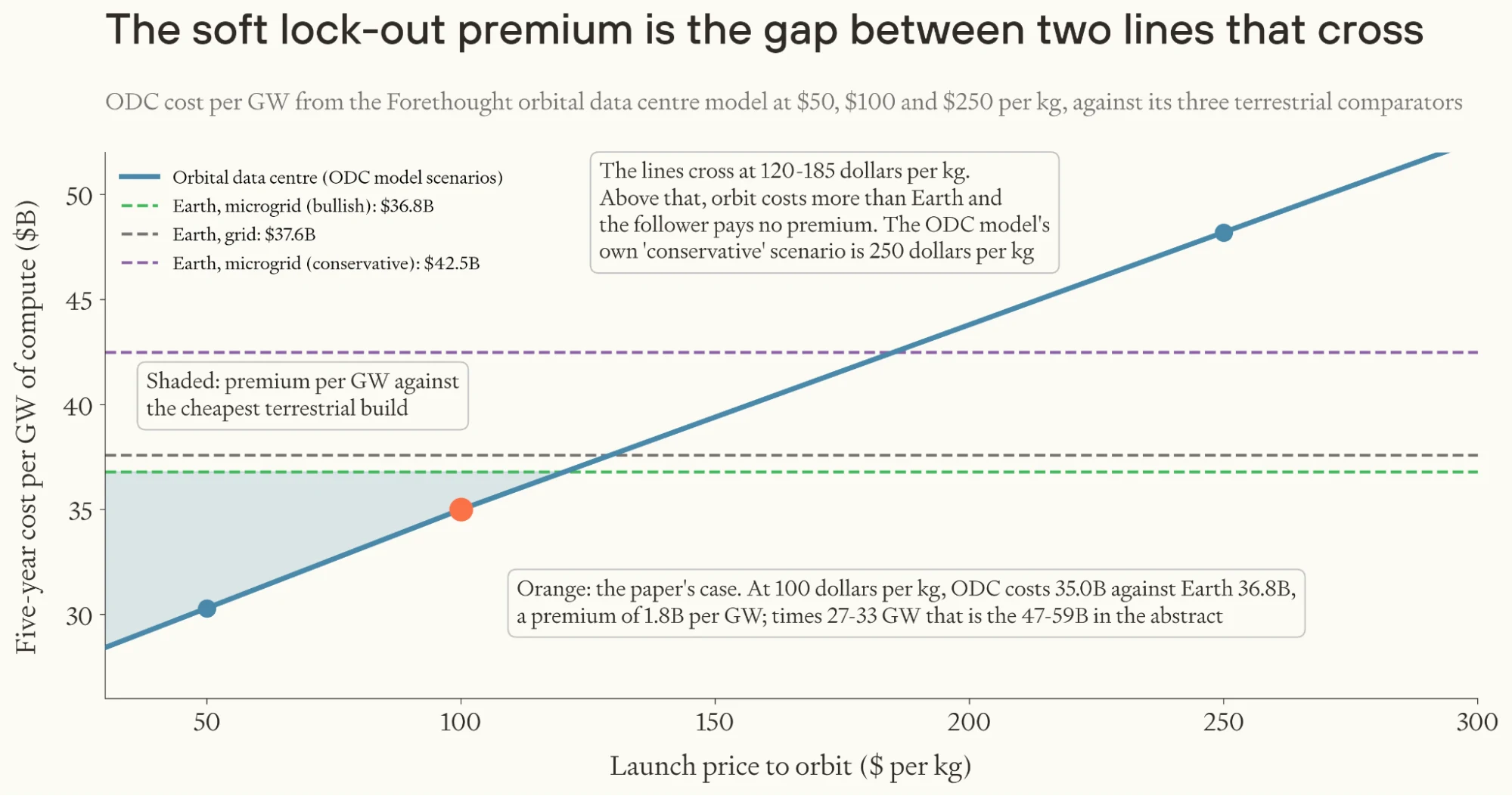
The premium a locked-out follower pays is the vertical gap between the orbital cost line and the terrestrial comparator, and the lines cross at $120–185 per kg. Below the crossing the premium is $0–12B per GW depending on the comparator; above it there is no workaround cost for later entrants:
Image
Appendix 2: The best locations on the Moon
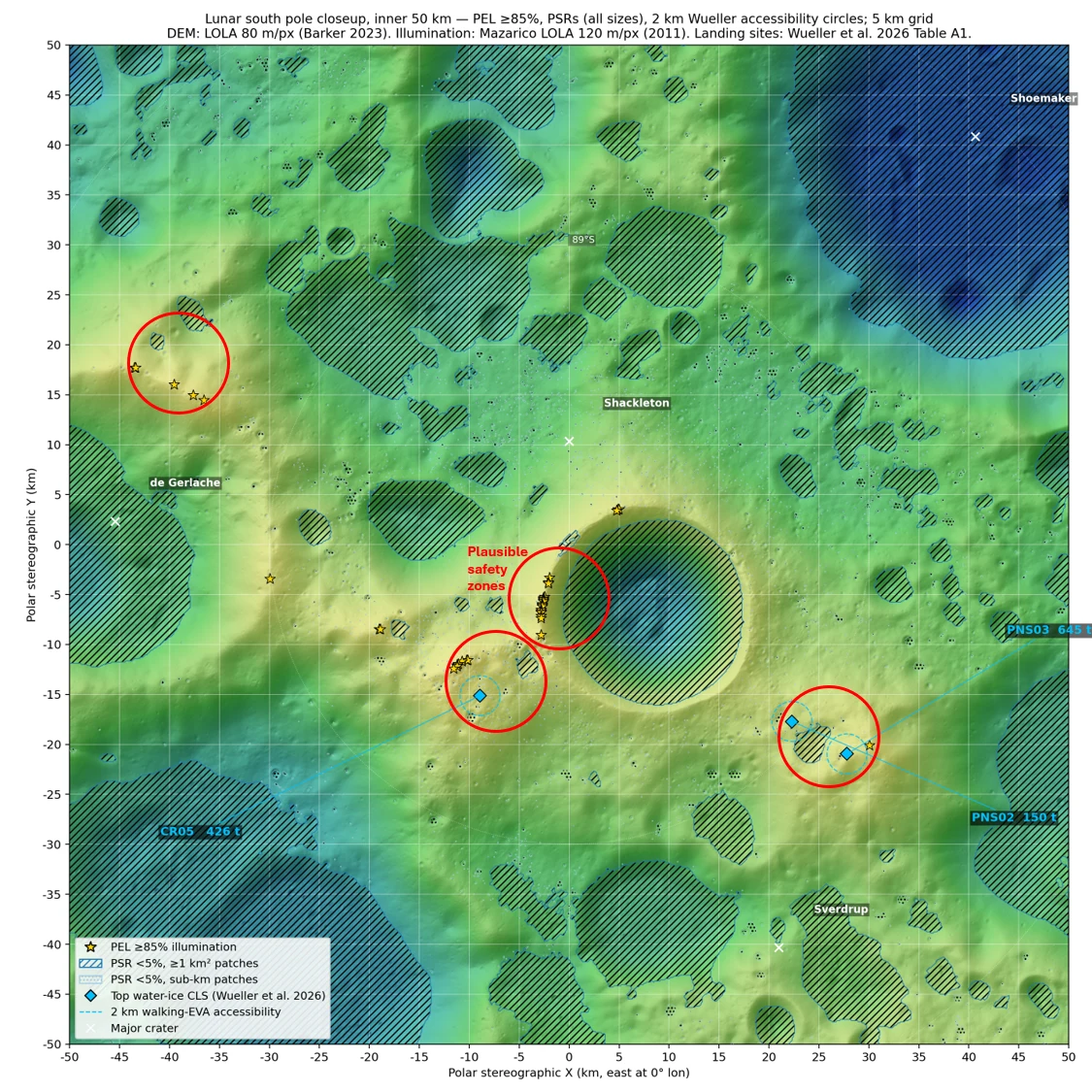
This appendix identifies the best lunar sites and prices the cheapest workaround for a rival denied them. The most valuable lunar sites include volatiles (mainly water ice) in permanently shadowed regions (PSRs), near-permanent power on adjacent peaks of eternal light (PELs; lit 80–95% of the year), and flat ground for landing pads and construction. Wueller et al. identified 130 candidate sites across 16 polar regions but modelled accessible ice, as an upper bound, only for those in four of them; across those, three sites dominate the accessible water ice tonnage: PNS03 (~645 t), CR05 (~426 t), and PNS02 (~150 t), which together hold up to ~1,221 t of water ice, about half the modelled total.
This map shows the PSRs (dotted and lined shading) and PELs (stars; 85% annual illumination) in the south polar region of the Moon. CR05, PNS03, and PNS02 are shown by blue diamonds, with the 2 km-radius areas reachable on foot (a walking EVA), within which Wueller et al. modelled the water ice tonnage. PNS03 and PNS02 could be claimed with one safety zone and CR05 with another (red circles; 5 km in each direction), and we identify two other locations that look valuable, particularly the PELs along the de Gerlache–Shackleton ridge.
Image
Taking the locked-out rival's cheapest workaround as the measure:
- Importing the equivalent ~1,200 t of water to the lunar surface at a post-Starship delivered cost of ~$1,000/kg is ~$1.2B.
- Solar arrays could be lofted onto poles in areas that are just below the altitude for peaks of eternal light.76 A later entrant could build solar arrays and loft them on ~30–50 m masts to gain the same ~90% capacity factor of the PELs (clearing local terrain and catching the low polar sun). For a ~1 MW base, ~20 deployable masts weighing ~0.5 t each, the total mass is ~10 t, and extra panels to offset the lower capacity factor bring it up to ~20 t in total.77 That would cost (at $1,000/kg) about $20M.78 This is, of course, a very rough estimate.
- Flat ground: If a later entrant has to build a 2,000 m2 landing pad using imported blast-plating at 30 kg/m2 (60 t), then two such pads plus their foundations come to ~150 t of substructure,79 costing (at $1,000/kg) about $150M.
Adding these together, a later entrant could import ~1,370 t to the Moon (~1,200 t of water, ~20 t of masts and panels, ~150 t of pad substructure).80 Our best guess is that by the time nations and companies are grabbing sites on the Moon, costs will sit in the $1,000–10,000/kg range, making the workaround ~$1.4–14B (leaning more towards $14B).
Helium-3 (at 4–20 ppb) and rare earths (spread across ~10% of the surface) are too diffuse to grab as point locations, so we don't consider them “scarce, non-substitutable assets” that would confer the ability to lock out rivals.
Appendix 3: Hard lock-out with kinetic interceptors
This appendix builds on an analysis from Parrack (2026, forthcoming, Forethought), which develops the interceptor sizing model, the trench model of orbital warfare, and the cost-exchange estimates in the context of nuclear deterrence. Here we adapt that analysis to the question of lock-out.
We will analyse the possibility of the US achieving hard lock-out through the destruction of rockets using kinetic interceptors. We focus on the US because 85% of mass launched into orbit in 2025 was US-owned, and it is already developing a global kinetic interceptor system, Golden Dome, focused on missile defence.
Since the US already dominates space activities to this extent, our baseline case is that it will continue to do so. However, we are most interested in whether it is possible for the US to selectively deny access to space to anyone else. We analyse that possibility in this appendix, and find that kinetic interceptors layered across multiple orbits represent a credible pathway to hard lock-out. The total cost for this lock-out is at minimum $10–16B, and possibly as high as $150–390B for fully comprehensive coverage.
Counterspace weapons
We start by surveying existing counterspace weapons (weapons designed to attack targets in space). For hard lock-out to confer a decisive strategic advantage, the launch leader would have to defend its kinetic interceptors in order to keep using them to lock out adversaries. If an adversary with weaker space capabilities can just cheaply destroy the leader's space assets, then hard lock-out is unlikely to be effective. The two attacks that come closest to doing so are nuclear detonation in orbit and deliberate debris creation, which we take up under Rivals' responses below.
A first point that cuts against the possibility of cheaply destroying space assets is that attacks from the Earth's surface are not very effective against satellites positioned at high altitudes. Weapons like ground lasers to dazzle sensors are similarly ineffective against targets above low-Earth orbit due to the vast distances and atmospheric attenuation. Additionally, the higher the altitude of the space asset, the harder it is to destroy it with a missile launched from the ground. A missile shot from the ground would take only a few minutes to reach low-Earth orbit, but roughly ~2 hours to reach 20,000 km (~medium-Earth orbit). A space asset in GEO could be launched with enough fuel to manoeuvre away from the kill vehicle at hundreds of metres per second.81
However, while high-altitude satellites may be safer from ground-based attacks, military assets staged in space (which might shoot interceptors at satellites, attach to spacecraft, or intentionally collide with them) could still interfere with high-altitude satellites. But the launch leader would be more capable of placing these military assets in space than any adversary.
Nevertheless, it's worth going over the different counterspace weapons. We separate three grades of counterspace weapon depending on how permanent they are and whether they leave debris:
- Suppression: suppressing the functioning of a space asset without permanently disabling it, e.g. jamming a satellite link or dazzling its sensors with low-power lasers. These tend to be cheap and deniable, and are used routinely.
- Soft kill: permanently disabling a satellite without breaking it into fragments.
- Hard kill: physically destroying a spacecraft into fragments with a kinetic impact. This creates debris that threatens other satellites in the same orbital band.
There are various counterspace weapon classes:
- Ground lasers/dazzlers are high-power beams fired from the ground into a satellite's sensors. They are a mature weapon (e.g. Russia's Peresvet). They would be suppression-type weapons in most cases, but may also be used to soft kill targets by permanently blinding them. They can only really be effective against targets in low-Earth orbit, since higher orbits require increasingly powerful lasers.
- Cyber attacks could be used to suppress space assets. However, hijacking hardened military satellites seems extremely difficult. Their tracking and command paths use authenticated and encrypted links, and there's no case of one ever being hijacked. Due to various slips in cybersecurity standards82 alongside advances in AI, it may become much easier to hack space assets. However, hacking satellites is reversible, as operators can redirect away from compromised ground stations, change access codes, or patch the systems that were hacked, usually within hours to days.
- Direct-ascent anti-satellite (ASAT) weapons can be launched from the ground to directly ascend towards a target and destroy it (hard kill) without going into orbit. ASAT weapons could theoretically reach any height, but the higher the altitude of the target, the more warning time it gets. ASATs have been tested to a range of altitudes by China (865 km, 2007), the US (555 km, 1985), Russia (~480 km, 2021), and India (283 km, 2019); China has separately lofted a ballistic object to ~30,000 km.
- Co-orbital weapons are staged in orbit already and can approach other space assets to inspect them, attach to them, or destroy them. They can be used for either suppression, soft kills, or hard kills, depending on the weapon type. China's Shijian-21, for example, docked with a defunct satellite and towed it ~3,000 km above its previous position.
- Space-based interceptors would be positioned in space, and would fire a projectile at a target for a hard kill. They can reach a satellite in whatever orbit they occupy, where the limit of their reach is set by the interceptor's delta-v budget and the time available to close on the target. No-one has ever fielded a space-based interceptor layer, as far as we know.83
- A nuclear detonation in orbit would soft kill many targets by damaging their electronics with radiation, potentially affecting all satellites in low-Earth orbit. Starfish Prime, a 1.4 Mt US device detonated at ~400 km (low-Earth orbit) in 1962, damaged or disabled 9 of the roughly two dozen satellites then in orbit, most of them over the following weeks and months through the artificial radiation belt it created.
- Deliberate debris creation could make an orbital band unusable by destroying any asset that tries to use the same band.
Overall, we think kinetic interceptors are the most powerful counterspace weapon, especially for lock-out: they can intercept rockets during their boost phase or destroy rivals' space assets. Ground-based attack loses effectiveness quickly with altitude, cyber attack is reversible, and co-orbital attack needs to launch objects into space, which could be destroyed by the interceptors. So a weaker rival has no cheap way to clear the leader's interceptors from orbit. Direct-ascent ASATs can reach them, but trade slightly in the leader's favour on cost. The exceptions are the levelling attacks: a nuclear burst in orbit or a deliberate debris release, which we price below.
A trench model for orbital warfare
We will focus on kinetic interceptors staged in orbit. Different orbits have different advantages:
- Very low-Earth orbit (VLEO; 200–350 km) is close enough to the ground to rapidly intercept rockets during their boost phase, and debris at this altitude quickly falls back through the atmosphere, limiting self-harm. However, the low altitude also means that assets staged here must constantly use propellant to stay in orbit. Assets in VLEO are also most vulnerable to attacks from the ground, like ground lasers and dazzlers.
- Low-Earth orbits (LEO; 350–2,000 km) are more easily maintained and boost-phase interception can still happen. Kinetic interceptors in LEO are also high up enough to intercept ASAT weapons launched to destroy them. Assets in LEO likely remain exposed to ground-based dazzlers and potentially to future directed-energy weapons. Given that the overwhelming majority of satellites also sit in LEO currently, this is broadly the only region that is at risk from large-scale debris cascades.
- Medium and geosynchronous Earth orbits (MEO / GEO; ~2,000–36,000 km) are much harder to hit with direct-ascent ASAT weapons, but interceptors there would struggle to intercept rockets in time to deny launch. However, they would have a wide view of everything below, and could attack rivals' assets in lower orbital layers84 or defend their own. Assets in GEO could also attack other assets in these high orbits to deny access to positioning, navigation and timing information, or communications. Assets here are also less vulnerable to a Kessler cascade.
The launch leader could stage kinetic interceptors across these different orbital regimes so that the interceptors complement each other. In a sense, this is like having several independent lines of defence: no single conventional attack can destroy the whole operation. The exception is the nuclear leveller, which disables the vast majority of unhardened assets in low orbit within weeks to months; we treat that case separately below. In the context of denying access to outer space, we call this a trench model for orbital warfare. We think taking the high ground (MEO, ~20,000 km) in particular is an effective strategy.
How many interceptors are needed?
We described a multi-layer system of kinetic interceptors designed to attack any rockets launched from Earth, or destroy rivals' space assets. In this section, we ask how many kinetic interceptors would be needed to achieve hard lock-out. The sizing model is available as a workbook here.
There are two main strategies to achieve hard lock-out, and they differ in which layer holds most of the interceptors:
- Intercepting rockets during their boost phase (interceptors in LEO). Interceptors in low-Earth orbit can intercept rockets during their brightest and slowest phase, but this requires many more interceptors for global coverage, and most of them are not able to intercept rockets at any given moment.
- Intercepting rockets or their payloads at higher orbits (interceptors in MEO). Fielding interceptors in higher orbits (like medium-Earth orbit) gains much greater coverage, but the rockets would be harder to intercept and could deploy multiple payloads before being intercepted.
To intercept rockets during their boost phase, continuous coverage of all launch sites on Earth requires tiling one interceptor's ground footprint over the sphere at the intercept altitude, with an overhead factor k for imperfect packing and for the fraction of time an interceptor is usefully positioned:
N₁ ≈ k · 4π(R⊕ + h_int)² / (πr_f²) = 4k · (R⊕ + h_int)² / r_f²
with R⊕ the Earth's radius, hint the intercept altitude, and k ≈ 1.6.85 Both the footprint and the sphere it tiles are taken at the intercept altitude, on radius R⊕ + h_int, so the two are consistent. We assume the interceptors orbit at 400 km (above VLEO, so no continuous station-keeping) and that the intercept itself occurs at ~150 km altitude, during powered ascent. A ~350 kg interceptor with ~3 km/s of flyout,86 given the ~250–300 s usable slice of a rocket's 8–10 minute boost, has a slant reach of 675–810 km. Measured as a spherical arc on the 150 km intercept sphere, that gives a footprint of radius r_f ≈ 620–760 km in which it could intercept any launching rocket.
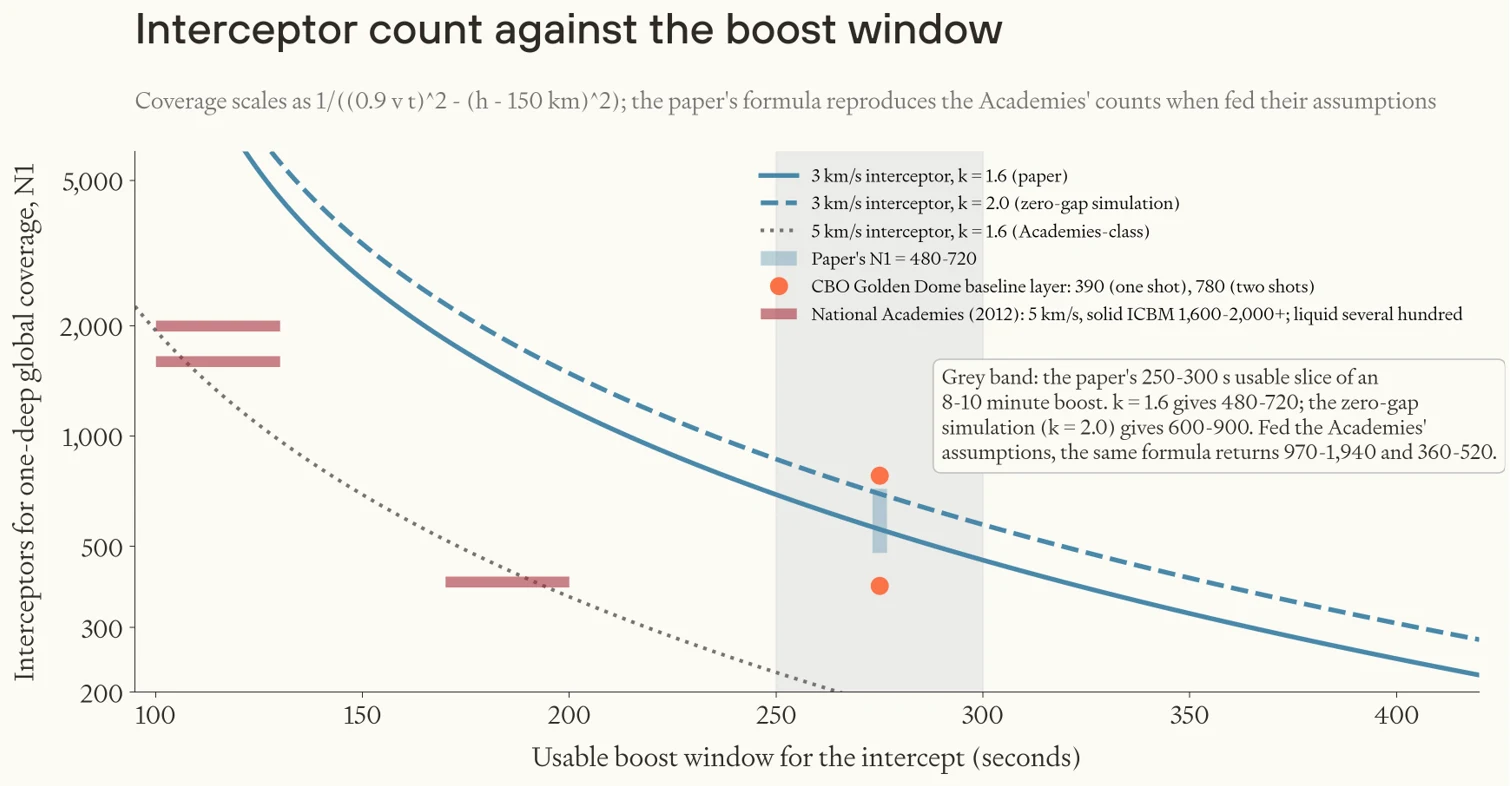
For these interceptors to be covering the entire Earth at any given time, so that any rocket can be intercepted during its boost phase, roughly 480–720 interceptors are needed (assuming the 250–300 s usable slice). As a check on the number of interceptors, the Congressional Budget Office made a cost estimate87 for space-based boost-phase interceptors, which implies ~780 interceptors in orbit to guarantee intercepts (or ~390 if we ignore their 2-shots-per-kill assumption that we don't make), making their estimate about 19–46% below our range. Fewer interceptors are needed if rockets have longer boost phases (as this gives more time for interceptors to get into range and hit the target).88 The number of interceptors needed scales as ~1/((0.9vt)² − (h−150)²), which means that a 30% longer window reduces the constellation by ~45%, while a 30% shorter one (a fast-burning solid booster, say) multiplies it by ~2.4:89
Image
If the boost phase is less than ~93 seconds, then it doesn't seem possible for any interceptor system to get total coverage. The comprehensive system in this research note requires more than 153 seconds. Fast-burn small-lift vehicles like Kuaizhou or Ceres-1 may be near those boundaries, which is why the higher layers matter for destroying anything that gets through the lower layers (next paragraph).90 We assume each interceptor kills its target (shots per target S 1, i.e. Pₖ ≈ 1). If we assumed two shots per target, the comprehensive tier would roughly double to ~13,800–35,600 interceptors.
To intercept rockets at higher orbits, far fewer interceptors are needed because the interceptors don't have to be within a few hundred kilometres of the rocket during the short window in which they can intercept it. If interceptors are placed at 20,000 km, they would have line of sight to about 55–70% of low-Earth orbit (and this rises the higher the interceptors are). So, ~24 platforms of kinetic interceptors on different inclined orbital planes would have at least 12 platforms in line of sight of all of LEO at any given time. This doesn't mean they can guarantee intercept of everything rapidly, but if something is orbiting in LEO then the constellation of interceptors will be able to wait until it is in range and destroy it. An interceptor dropping from the 20,000 km layer could reach a target in low-Earth orbit in roughly three hours, for as little as ~1.4 km/s of Δv.91 However, a payload with even a small thruster (tens of m/s of manoeuvring capability) can move hundreds of kilometres during the interceptor's three-hour descent, far beyond the interceptor's ability to correct its course on final approach. So the MEO layer is best understood as holding slow-commissioning, high-value payloads at risk: cheap fractionated payloads that work on separation largely defeat it (we return to this in the marginal-exchange section below and, for mobile small-lift launch, in the oversizing section).
The major trade-off is that these are slower engagements. For example, dropping an interceptor from the 20,000 km layer to LEO takes ~3 hours. The rocket will then have completed its boost phase and may have time to dispense several payloads or decoys before interception.
In reality, whether to concentrate interceptor density in MEO or LEO depends on the response of the rivals being locked out. If they focus on building larger rockets that can hold many payloads, then the interceptors in MEO would have to intercept many different payloads at once. However, if rivals focus on building more launch pads and developing a greater ability to launch many rockets at once, then the layer in LEO would require massive oversizing (see “Oversizing the low-Earth orbit layer” below). So, an agent locking others out of space would likely deploy its interceptors across these different orbits, and build up capacity where it is most needed. Big rockets attempting to overwhelm MEO would be defeated by the interceptors in LEO for a low cost, and many rockets attempting to overwhelm interceptors in LEO would be caught by interceptors in MEO, at least where their payloads are the large, slow-commissioning kind that layer can hold at risk.
Who wins on the marginal exchange and in a war of attrition?
It could also be that these kinds of military advantages are affordable to field but not affordable to sustain, so the more important overall measure is the cost-exchange ratio: the launch leader's marginal cost to negate one more of a rival's vehicles, against that vehicle's own cost. The answer is mixed based on the analysis below. The leader can maintain space-domain denial, coming slightly ahead on the cost exchange with direct-ascent ASAT weapons, but loses the cost exchange against extra launch pads.
We include two separate cost conventions below:
- Replacement pricing (the cost of one more interceptor) applies when replacing kinetic interceptors at the end of their lifetimes.
- Capacity pricing (buying another full coverage layer) applies when the leader must guarantee a kill at an adversary-chosen time and place.
We flag when each is in use.
Space-domain denial (i.e. denying a rival useful presence in orbit, as opposed to stopping the launch itself) runs strongly in the launch leader's favour, at least against payloads the MEO layer can hold at risk. Destroying rockets during their boost phase (true launch denial) can be expensive because it forces oversizing to stay in range of all the launch pads. However, for destroying any object in space, many fewer interceptors can be deployed to catch everything. A space asset can be intercepted while it is finishing commissioning or reaching its destination, which can take hours to days. So, the MEO layer drops the absentee ratio (interceptors bought per interceptor in position to engage) to about 2:1. For example, two interceptors (call it $20–44M) could destroy a launch and payload worth anywhere from about $100M for a routine satellite to $1B and up for a major constellation or deep-space mission. So, space-domain denial (not just launch denial) looks like it runs on the order of 2–50× in favour of the first mover to deploy interceptors across many orbital layers, depending on interceptor cost and how valuable the payload it kills is, with a central case of about 7× (a ~$300M payload against two $22M interceptors).
Against a direct attack on the constellation, the launch leader looks modestly favoured in a war of attrition. Direct-ascent ASATs are large missiles and have to climb out of the atmosphere to the orbit of the interceptor they are attacking. The cost of the missile is ~$28M vs the cost of each interceptor being ~$22M in our models (plausibly as low as $10M, but ASAT weapons costs could also fall), roughly 1.3:1 in the leader's favour. The interceptors can destroy ASAT weapons as they ascend, in the same way they could destroy rockets or ICBMs, so they trade 1:1. So the cost exchange is at best slightly in favour of the leader. The leader can amortise the cost of climbing out of Earth's gravity well by launching many interceptors at once, whereas the ASAT weapon is a single launch for a single kill.
One thing that a locked-out actor can do to make the cost balance more in their favour is build more launch pads. New launch pads mean the leader has to oversize the layer of kinetic interceptors, which would be ~790–1,410 interceptors.92 Pads that are added to one footprint would all be at roughly the same latitude, so rather than adding a whole new uniform layer, the leader could launch extra interceptors into orbits inclined to match that latitude, where an inclined shell is densest (a satellite at inclination i spends most of its time near latitude ±i). Our estimate is that this would take only ~200–300 additional interceptors, costing ~$4–7B at the $22M unit.93 Overall, though, the cost exchange is 4–7× against a $1B pad and 14–44× at realistic pad prices (~$150–300M). The leader could also prevent leakage of rockets through the kinetic interceptors by building more higher layers or attacking the launch pads during construction, which risks converting lock-out into a war.
Leak-proof nuclear missile defence is expensive.94 Even more expensive than launch denial and defending against ASAT weapons is destroying nuclear ICBMs. As with the ASAT weapons, if a rival builds more nuclear silos that can fire nuclear weapons from within the same footprint, the leader has to oversize the layer to intercept them (another layer is ≈ 480–720 interceptors, priced here as a full uniform layer; concentrating the extra depth over the silo field's latitude, as for launch pads above, would cut this to ~200–300 interceptors and the exchange below to roughly 27–41× against the leader). If a rival can fire hundreds of nuclear weapons at once, this would require having staged tens of thousands of interceptors costing trillions of dollars to intercept them,95 which is partly a reflection of the massive nuclear weapons capabilities that nations have developed. This forces the leader to place lots of interceptors in orbit that don't get used: roughly $10.5–15.8B at the $22M unit, or $4.8–7.2B if interceptors mature to ~$10M, but the ICBM would only be worth about $160M ($100M missile plus three ~$20M re-entry vehicles). That is a cost-exchange of roughly 65–99× in the rival's favour, or 30–45× at the mature interceptor unit cost. So, the leader would be out-traded on nuclear defence, and leak-proof nuclear defence would be extremely costly.
Kessler syndrome and nuclear weapons in orbit. An adversary denied space access could detonate a nuclear weapon in orbit or deliberately initiate Kessler syndrome as a levelling attack. Stopping that reliably would require the same leak-proof, near-peer-scale defence as the nuclear missile defence, probably prohibitively costly. This is a problem for lock-out, but doesn't seem to make it impossible for the leader to lock out space access; the attack itself, and what the leader keeps after it, are covered under “Rivals’ responses” below.
Command of the space commons (i.e. no rival operating in orbit without the launch leader's leave, and the leader free to attack and defend orbital assets) seems plausibly achievable and even cheap. A survivable hard blockade of a rival determined to burn the commons is harder and rides on whether nuclear deterrence deters the levelling response.
Space-based directed-energy weapons could eventually change the economics further. While each kinetic interceptor is single-use, a laser could fire repeatedly at light speed, so it has some powerful strengths over interceptors. The main drawback of lasers is that they don't have as good a range: a 500 kW, 4 m-aperture laser — well beyond anything yet fielded (the best fielded electric lasers are 60–100 kW, and no large aperture has been space-qualified) — would deliver only ~0.3 W/cm² at 25,000 km, enough to dazzle or damage a sensor, but not to destroy space assets. They would be effective space-to-space weapons, though. At ~1,000 km distance a 500 kW, 4 m-aperture laser could deliver ~170 W/cm², a soft-kill capability. So directed energy plausibly matters first as a sensor-kill and close-range weapon; wide-area laser denial from high orbit would require apertures and powers several orders of magnitude beyond current designs.96
Rivals' responses
Nuclear detonations in orbit. A nation locked out of access to space could also threaten to destroy a large fraction of satellites in orbit with nuclear detonations. Stationing a nuclear weapon in orbit would breach Article IV of the Outer Space Treaty, and detonating one in space is banned by the 1963 Partial Test Ban Treaty.97 A comprehensive system would engage orbital launches carrying nuclear payloads, but a high-altitude detonation does not need an orbital launch: Starfish Prime rode a Thor missile on a suborbital trajectory with a ~2.5-minute boost, below the usable window the LEO layer is sized for, so the intercept could not be guaranteed against an attacker choosing the time and place. The leveller can only be deterred. Nor would intercepting launches help if the ability to initiate a nuclear explosion was already latent in orbit.98 A nuclear detonation in orbit or a deliberate release of debris could trigger Kessler syndrome, and both are cheap relative to the constellations they threaten. A high-altitude nuclear burst is estimated to promptly jeopardise on the order of 20% of low-orbit satellites (for a device of 110 kt or more), and the artificial radiation belt it generates could disable a much larger fraction — the vast majority of unhardened LEO satellites within a few weeks to two months (a DTRA study finds unhardened LEO satellites at serious risk of exceeding lifetime radiation-dose limits within weeks to months), with the belt persisting for months to a year. With debris, a few hundred tonnes of fragments deliberately spread across the 800–1,000 km orbital band could destroy all the satellites there and make operation difficult for decades (launching through it would still be possible). These levelling attacks seem to form a sizeable check on the ability of a launch leader to dominate orbit. The launch leader can hold reserves in MEO beyond the reach of these threats, though as noted above cheap fractionated payloads largely defeat the denial value of that layer, so what leaves the leader standing is mainly its untouched launch base and the cadence to re-field a boost-phase layer first. The launch leader may also be able to replace much of what it loses in LEO by falling back to VLEO.99
Attacking the space leader on Earth. In an extreme scenario, a locked-out rival could also escalate the conflict and attempt to strike the spaceports of a leader using missiles, locking out everyone (a 'spoiling' or 'sabotaging' attack). Once a leader fields interceptors, the rival's ballistic options are partly contested — though guaranteeing those intercepts is the leak-proof case priced above — and its non-ballistic options bypass the boost-phase layer entirely. If the use or threat of such weapons destroyed the leader's spaceports, the leader would retain the orbital layer and could still block the rival's launches, but would lose its interceptor replacement line; the layer then decays on its ~5-year service life. The deadlock then turns on whether the leader rebuilds its launch capacity before its own interceptors expire: likely, but not certainly, it does, and the rival can at least force that race to be run. If the leader wins it, the rival has only delayed the lock-out, and would have to use that delay to escape it another way: allying with nations that have higher launch cadence, building more launch pads, or growing its economy to overcome the cost asymmetry.
Oversizing the low-Earth orbit layer
For interceptors in low-Earth orbit, ~480–720 units ensure that at least one interceptor is in reach of a rocket launched from any site on Earth. However, if two rockets were launched at the same time from two pads (a coincident salvo) within one interceptor's coverage footprint, then the second rocket might make it through. To ensure global coverage against such a salvo, the number of interceptors needed would double, because intercepting the first rocket would use up the interceptor assigned to that location. An adversary being locked out could take advantage of this dynamic, and fire as many rockets as it can in a short period of time from the same location to overload the system and break through. So, the constellation has to be oversized by the largest coincident salvo it might need to defeat100. Writing that number as D, the constellation becomes N = N₁ × D, where N₁ ≈ 480–720 is the baseline coverage layer above.
Rockets launch from pads, so D is bounded by how many pads an adversary can fire within a single footprint, within a few minutes of each other. In China, Jiuquan alone has 12 orbital pads that have each flown at least once, eight of them more than once, all within ~20 km of each other; Taiyuan sits 990 km away with four more active pads,101 and the map below shows the cluster.102 Firing every pad nearly at once would be the limit of what a fixed-pad salvo could do, and would be quite difficult: even decoy rockets need launch infrastructure, communications, and timing that these sites were not designed to exercise simultaneously.103
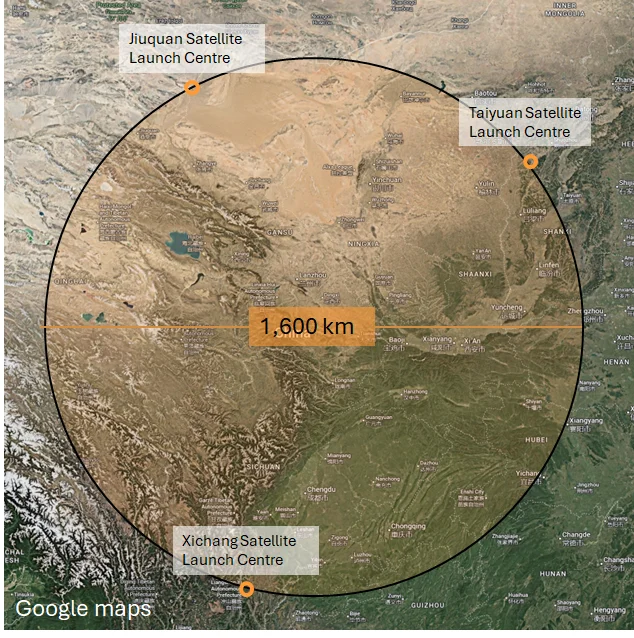
Image
Two effects size the oversizing:
- Decoys: these would be a bare booster without a payload (~$4.5M for a Ceres-1, ~$7.5M for an Electron) and would trade ~3–5× in the rival's favour against $22M interceptors. The best solution to maintain lock-out seems to be to have each interceptor wait ~60 s to judge from each rocket's acceleration and trajectory whether it is carrying a payload before firing. Waiting would reduce the footprints of the interceptors, requiring more interceptors, and increasing the cost of the whole system by ~1.7–2.0× on the whole baseline layer.104 How reliably a loaded rocket can be told from a ballasted decoy in that time is untested; if it cannot, the 1.7–2.0× factor disappears but the 3–5× decoy exchange applies to every launch.
- Coincident salvos: even after delaying, the footprint of each interceptor (diameter ~880–1,170 km) is still wide enough to cover Jiuquan's 12 orbital pads but does not reliably span two major spaceports (Jiuquan–Taiyuan is ~990 km apart). We assume that the largest number of rockets a rival could fire at nearly the same moment from inside one interceptor's footprint is 8–12.
Combined, N = N₁ × (1.7–2.0) × (8–12) ≈ 13–24× oversizing, i.e. ~6,300–16,900 interceptors in the low-Earth-orbit layer. This is a little bit arbitrary, but costing it against a salvo depth of 8–12, when no state has yet launched two orbital rockets from inside one footprint within a boost window (the record interval is 3 h 36 min), is on the conservative end. Even if some rockets do manage to get through this layer, interceptors at higher orbits could intercept slow-commissioning payloads.
Interceptor hardware against the salvo depth the layer must defeat:105
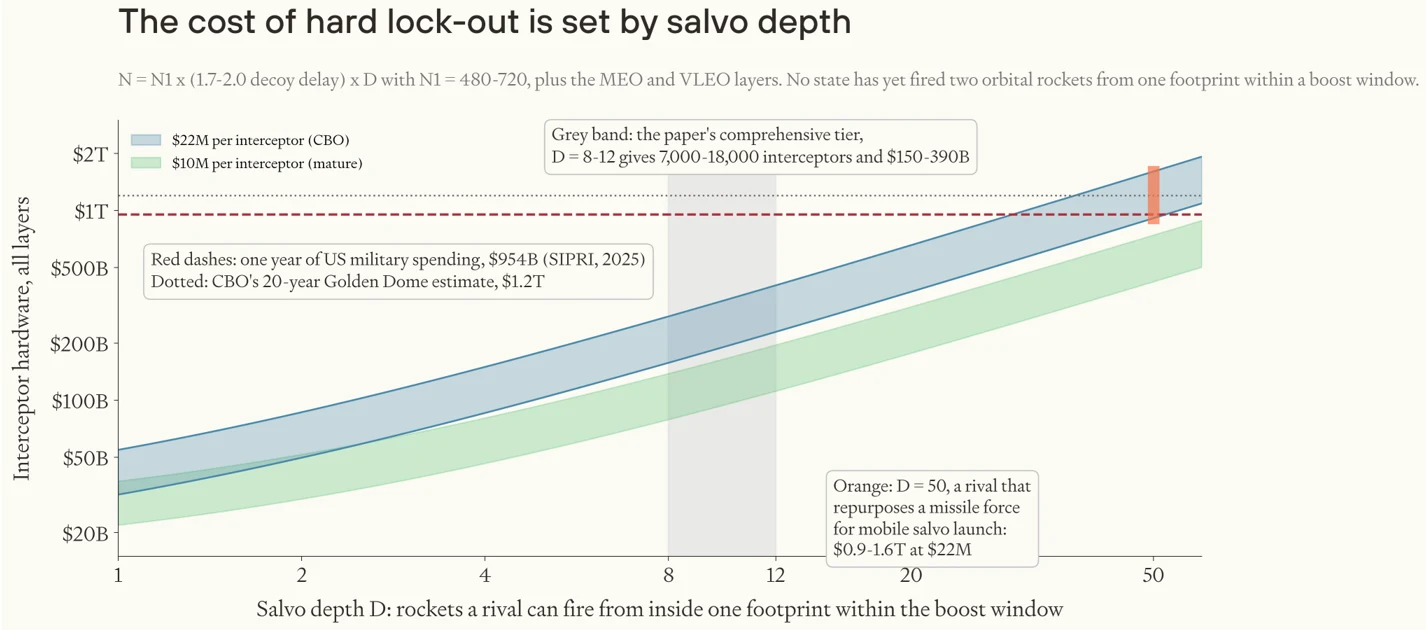
Image
One issue with this estimate is that the oversizing (8–12 pads) only accounts for fixed pads, i.e. launch pads that are on the ground. However, China already launches rockets and other missiles from mobile transporters and sea platforms (e.g. Long March 11, Kuaizhou, Ceres-1, Jielong-3, and Gravity-1), which can move to concentrate themselves inside any footprint. Russia has put a satellite in orbit from a submarine (Tubsat-N, 1998). Additionally, ICBMs have been converted into space launchers (e.g. Start-1, Rokot, Dnepr, and Minotaur). If a rival converts even a fraction of a missile-scale force to salvo launch, the number of rockets they can launch is bounded by production rather than pads: at a coincident salvo of 50 rockets, the LEO layer alone would cost ~$0.9–1.6T. However, these vehicles are mostly small (~0.3–1.5 t to LEO for the road-mobile (TEL-based) types, though Gravity-1 lifts ~6.5 t from a ship), so leakers would reach orbit as smallsats rather than heavy infrastructure. The MEO layer could then deny them access to orbit, where cheap fractionated payloads already favour the rival. Salvo-scale mobile operations are also observable in advance, giving the leader warning to thicken coverage locally.106
How much would it cost?
The cost to field a constellation of kinetic interceptors depends on many assumptions, like the cost of interceptors, launch costs, the reactions of rivals, the effectiveness of the interceptors, and how long rockets spend in boost. So the cost estimates we come to should be taken as a general indication.
Kinetic interceptors cost ~$10–22M each107 including launch cost,108 but we price everything below at the top of that range. This is the estimated Golden Dome interceptor cost of $22M per unit.109 We can use this to derive the price of hard lock-out at each level of oversizing, where the minimum (no oversizing; 480–720 interceptors) cost is ~$10–16B, 2× oversizing costs ~$21–32B, and the comprehensive case (13–24× oversizing) costs ~$140–370B for the LEO layer alone. Even the comprehensive case is well within the US defence budget of ~$954B.
Adding a higher-altitude layer, as per the trench warfare model, would cost ~$4.1–8.9B including the platform buses (~$3.1–5.3B for the ~140–240 interceptors alone, which is the figure the tier totals below use).110 A forward layer in very low orbit for rapid interception would cost ~$9.7–14.1B.111 These are still low costs relative to the budgets of the most powerful nations.
To summarise:
- Minimum cost: no oversizing, LEO layer only (~480–720 interceptors): ~$10–16B.
- Intermediate (2×) tier: 2× oversizing plus the MEO and VLEO layers (~1,500–2,300 interceptors): ~$34–51B.
- Comprehensive (sized against today's fixed-pad geometry) cost: 13–24× oversized LEO layer plus MEO and VLEO layers (~7,000–18,000 interceptors): ~$150–390B at the $22M unit, or ~$70–180B at a mature ~$10M unit.112
The table lists the inputs the headline numbers depend on, where each comes from, which way it leans, and what happens if it moves:113
| Input | Value used | Where it comes from | Direction of bias | Effect if moved |
|---|---|---|---|---|
| Interceptor fly-out speed | 3 km/s | Assumed; Wright (2026) sizes 3.2 km/s for a 360 kg interceptor | Neutral | N₁ ∝ 1/((0.9vt)² − 2502): 2.5 km/s → +55%; 4.5 km/s → −59% |
| Usable boost window | 250–300 s | 8–10 min liquid boost less detection and climb; not yet derived from named vehicles | Optimistic against fast-burn solids | −30% → ×2.4; mostly below 153 s the comprehensive layer cannot guarantee coverage |
| Packing factor k | 1.6 | Assumed | Optimistic | Streets-of-coverage 1.95, simulation 2.0, Iridium 2.0, Teledesic 2.6: N₁ +22% to +63% |
| Shots per target | 1 | Assumed; CBO uses 2 | Optimistic | ×2 on every tier |
| Decoy-delay factor | 1.7–2.0 | 1/t2 scaling for a 60 s wait | Neutral | Linear |
| Salvo depth D | 8–12 | Jiuquan pad count; needs sub-second spacing; record inside one footprint 3 h 36 min | Pessimistic for the leader against demonstrated capability; optimistic against mobile launch | Linear: $32–55B at D = 1, $0.9–1.6T at D = 50 |
| Unit cost | $22M | CBO learning-curve price for a 7,800-unit buy | Optimistic against contracted analogues ($14–22M without a kill vehicle; $24–50M with) | Linear |
| Service life | 5 years | CBO; Starlink | Neutral | 3 years → replacement ×1.67 |
| In-plane spacing | 100 km | Aggressive close-packing | Generous to the capacity claim | Linear: 2,000 km → 49,000 slots |
| Terminator plane count | 16 of 72 | ≥93% annual illumination | Criterion-dependent, 12–22 | Aggregate ∝ count: $35–81B |
| Orbital cost per GW | $35.0B | ODC model, median $100/kg launch | Optimistic (conservative scenario $48.2B) | Premium 0 at ≥$120/kg; 6.5B per GW at $50/kg |
| Terrestrial cost per GW | $36.8B | ODC model, bullish microgrid | Optimistic for the follower (cheapest comparator) | Grid $37.6B → $2.6B per GW; conservative microgrid $42.5B → $7.5B per GW |
| Delivered price to the Moon | $1,000–10,000 per kg | Assumed post-Starship; CLPS today ~$1M per kg | Optimistic | Linear: $1.4B–$1.4T |