Can the US Afford to Pace the Frontier?
Citations
29th October 2026

After a series of incidents involving misaligned AI agents, including the hack of Hugging Face, technology leaders including Dario Amodei, Sam Altman, and Elon Musk have called for pacing the AI frontier. The concern is that as AIs help build more capable successors, a recursive self-improvement (RSI) loop could accelerate progress beyond our ability to keep control. But AI is also a powerful technology for economic and national strategic purposes, and slowing its development could put the US at a disadvantage against rivals, especially China.
In this post, I’ll take pacing to be a good idea on safety grounds, as these leading technologists do, and analyze it from the perspective of US national security. The question is how to weigh the risk of losing control of AI against the risk of losing a lead on AI, or, to put it simply, I want to know: can the US afford to “pace the frontier”?
By pacing I mean deliberately running frontier AI R&D below its maximum speed, for example by capping the compute labs spend on R&D, while continuing to deploy AI. I was initially unsure how the tradeoffs compare, but after some preliminary analysis, I’ll argue that pacing looks affordable for the US, because its real advantage is its multiyear lead on compute, rather than its few month lead on R&D.1 Here are the main points I think compelling:
- Pacing may cost the US little to no speed overall, and helps mitigate the risk of externalities. Failed training runs, forced pauses and a cancelled release have now cost at least one frontier lab (OpenAI) weeks to months. Moreover, hacks like the Hugging Face incident show that AI is now at the level of capability where safety failures could harm the American public or cause other externalities. Over the summer, OpenAI’s agents escaped their test environments, broke into Hugging Face, took over a German software wiki as a message board, pulled Census data using API keys found online, reposted SEC data, got into a non-public Medicare statistics portal and a New South Wales parks app in Australia. OpenAI has since notified more than 100 organizations of misaligned agent activity. If a steadier pace can avoid these missteps, it may not slow the US down at all, and could even match or beat a sprint.
- Pacing also buys time to secure US labs against espionage which protects a US lead. In reality, the US lead on AI is functionally illusory if, by distilling US models, stealing model weights or copying algorithmic secrets, China (or other states) can take up much or all of that lead overnight. Frontier labs are not currently on track to harden their security against a state actor, and would likely need help in doing so (RAND, 2024). Pacing would help the US have time to shore up this strategic vulnerability. In the absence of doing that, the US lead can’t be relied on.
- The real advantage the US has over China in AI is its compute advantage. That advantage is about 9-to-1, and a compute advantage means faster research. As AI has become increasingly capable, it has become increasingly useful in AI R&D, speeding up research. A compute advantage means researchers can run more experiments in parallel and employ more AI researchers. Research parallelizes imperfectly, so one leading US lab’s ~3.5x compute edge over a Chinese counterpart may amount to something like 1.9x faster research at equal capability. But this means that if the US burned some of its lead to shore up safety and security, this boost in research speed could then let it match China’s research speed with a fraction of its compute, or set R&D spend at, say, 2x China’s and thus grow its lead, while spending the rest on safety and security.
- The US compute advantage also gives the US more than 9x the AI manpower. Even if faster research didn’t pan out and US and Chinese AI stayed roughly at parity, the US could still deploy something like nine times as much AI. That amounts to something like 9x as many AI workers across the economic and military applications. That’s enough to put several AI defenders against every AI attacker China fields and still outnumber it everywhere else. 9x is also something of a floor, if China put half its compute into R&D then each US frontier lab could match that for a small fraction of its own compute, the US would then have roughly 17 times China’s compute left over for AI deployment.

Pacing may cost the US little to no speed overall
Firstly, we should consider the possibility that pacing leads to faster progress overall by reducing setbacks. This could be true in the way that runners pace themselves over the course of a long race. If the pace is too fast for the economy to support it, or for our democracy to adapt to the changes that AI brings, then frictions from backlash or forced halts would result in slower progress in the long run. Given the rapidly increasing power of the technology and the current levels of safety failure inside frontier labs both numerous minor setbacks or recalls and catastrophic failures seem possible. At the level of agentic misalignment we are now seeing, we should take seriously the possibility of a Three Mile Island or Hindenburg-like moment that triggers a slowdown for the entire US AI industry. A key externality is that when one lab has an accident the whole industry pays, but one lab that rushes ahead keeps its gains. Since frontier AI labs need to stay competitive to retain market share and grow revenue to invest in future training, each lab is pushed faster than the steadiest winning pace, and the pace that is best for the US overall would have to be set across the industry. An apt analogy would be to imagine AI companies, or the US and China, in an egg-and-spoon race, where the winning strategy is to move at a brisk pace, but not so fast as to risk dropping the egg. Likewise, a failed training run can send an AI company back to the start, wasting hundreds of millions of dollars and requiring three months or more of retraining if the model can’t be salvaged.
In fact, this has already happened. This September, OpenAI cancelled its latest model’s release after it failed key safety tests. Days earlier, an agent’s escape from its sandbox had prompted OpenAI’s second training pause in under three months, with training set to restart from scratch. Given the levels of safety failure we’ve been seeing recently investing now in safety may even prove a moat for US AI. If other states later struggle with these same issues but US firms have since built up a reputation for developing trustworthy and secure AI systems, then US AI may be preferred in the global market. Larger failures are also easy to picture. Uncontrolled agents could rightfully sour the public on AI, or seriously strain US relationships with its allies by hacking their infrastructure; Australia’s prime minister has already conveyed “extreme concern” to OpenAI. Dario Amodei has warned that an AI-run botnet could take over much of the internet within a year. Based on this recent evidence, absent oversight, the probability of a catastrophic setback also seems considerable. The right pacing formula, one that is flexible and endorses a brisk but sustainable pace, may mitigate downside risks and be the surest path to progress overall.
Pacing could also protect the US AI lead by buying time to improve security. We know that some fraction of China’s progress rides on copying America’s. Chinese AI firms have reportedly pulled billions of tokens from US frontier models to train their own, and frontier lab security cannot currently prevent a determined state from stealing their models. If the US races forward with leaky labs then distillation and copying limits how far ahead it can pull, and one stolen model could erase its capability lead overnight. Failing to secure its labs is therefore a strategic vulnerability and having a lead today is only so relevant while that vulnerability persists.
The US can work to mitigate the strategic risks of pacing
Currently the US lead over Chinese AI has been about 7 months on average.2 The US strategy would presumably be to pace the frontier while monitoring China’s progress on AI, or otherwise estimating their time to the frontier, ready to accelerate if needed. There are broadly two possibilities for how this then goes:
- If the arguments above are correct and failure to pace would lead to setbacks that slow US progress or failure to shore up security would let China skip to the frontier then a pacing strategy would pay off, giving the US steadier and faster progress overall, so that the US lead holds or grows.
- Alternatively, it could be that pacing slows the US down but not China, and the US would then see its lead eroding.
The latter possibility means that pacing does carry some strategic risks. For example, monitoring China might not be feasible, or the US might misestimate Chinese progress, potentially losing more of its lead than intended, or losing the lead entirely.
The US can blunt these risks. It can invest in intelligence on Chinese AI progress and compute build out, and design its pacing strategy to be flexible and responsive to Chinese progress. But the biggest safeguard, the reason pacing looks affordable, and something much more substantial than a few months of AI lead, is the US compute advantage.

The US has a 9 to 1 compute advantage and as AI improves, a compute advantage converts increasingly into a speed and manpower advantage
As mentioned above, the impetus to pace the AI frontier arises from entering an age in which AIs increasingly drive AI improvement. The more this happens, the more central a compute advantage becomes, since it increasingly converts into an advantage both in speed and in manpower. Suppose US pacing did burn its lead, and China caught up to parity at some higher level of AI capability than we have today. But the US has a compute advantage over China. How does this interact with pacing, and broadly how big of a deal does it seem to be? To answer that, let’s first look at how much AI compute the US and China have, respectively, and how that might evolve over the next few years.
Today the US has about nine times China’s AI compute, and it is building out new data centers faster. In the table below I compile some Epoch data to show the AI chips owned by each country’s firms, at the end of 2025 and project them forward to this month. Both nations’ compute stocks roughly doubled this year, but US firms add about ten times as many chips as Chinese firms, so the ratio of US to China compute either holds or edges up.
Today the US has about nine times China’s AI compute, and it is building out new data centers faster. In the table below I compile some Epoch data to show the AI chips owned by each country’s firms, at the end of 2025 and project them forward to this month. Both nations’ compute stocks roughly doubled this year, but US firms add about ten times as many chips as Chinese firms, so the ratio of US to China compute either holds or edges up.
| AI compute (H100e) | End-2025 (Epoch) | Mid-October 2026 (projected) |
|---|---|---|
| US-owned | ~14–16M | ~28–32M |
| China-owned, including ~0.7M smuggled | ~1.7–2.0M | ~3.0–3.6M |
| US : China | ~8x (7–9x) | ~9x (8–11x) |
So presently, the US has a large compute advantage over China, and it’s growing with time, at least in the near term. Now we can ask what that compute advantage amounts to, both in terms of the speed of AI capabilities progress and in terms of a sort of ‘manpower’ advantage in AI deployment.3
First, more compute means more AI researchers and more experiments running in parallel, speeding up AI R&D.
Once AI research is largely automated, the US compute advantage could give it a faster loop of self-improvement, allowing it to potentially hold its lead while spending less on R&D, or pull further ahead. At today’s level of AI capability, the US compute advantage offers some advantage in research speed since human researchers can run larger experiments and run more experiments in parallel. But as AI automates an increasing fraction of AI R&D, the advantage of compute is increasing, translating more directly into a speed advantage.
Here we might imagine the race between the US and China as a triathlon. Both states are on the swimming leg, with the US about 700 meters ahead. Next up is the bike race, but while China rides a Vespa with a top speed of about 60 mph — the US will be running a Harley-Davidson4 topping out around 110 mph, and we ask: can the US afford to potentially lose some of its 700-meter lead in the swim? Well, we might think, probably so.
As AIs become more useful in AI R&D, the US compute advantage confers a research-speed advantage of perhaps 1.9x. The relevant comparison for R&D speed would be lab to lab, rather than nation to nation. Competing US and Chinese labs often repeat one another’s work and don’t share their findings, so what matters is the compute each leading lab can bring to bear. Research also parallelizes imperfectly. Researchers duplicate work, spend time coordinating, and wait for experiments that take some fixed serial time to show what to try next.
To roughly estimate the net effect here, I’ll adapt Davidson and Houlden’s model of automated research, in which more compute supports both more AI researchers and more experiments, with diminishing returns and take Ord’s estimates of AI swarm scaling, suggesting a scaling exponent of ~0.5 as a decent rule of thumb based on the data we have so far. Then research speed just grows with the square root of compute.5 For the leading US lab let’s take OpenAI, at about 3.5 million H100-equivalents from the compute growth estimated above. For China, I’ll take ByteDance, combining owned chips with overseas rentals and assuming the same roughly 1.8x growth since 2025, for about one million H100-equivalents (range 0.3–2 million).
| Measure | October 2026 working estimate | Low–high |
|---|---|---|
| Leading US developer: provisionally OpenAI | 3.5 million H100-equivalents | Held fixed |
| Leading Chinese developer: provisionally ByteDance | 1 million H100-equivalents | 0.3–2 million |
| US developer’s compute advantage | 3.5× | 1.7–11.6× |
| Estimated research-speed advantage | 1.9× | 1.3–3.4× |
Doing this, I find an estimated research-speed advantage of about 1.9x which gives the US real strategic flexibility.6 It might for example, pace the frontier such that its research speed stays roughly at parity with China’s, then funnel a growing share of its compute into improving security and into extracting public benefits from AI deployment.
Second, more compute means more AI deployment, which runs more AI workers across the economy and, if needed, the military.
Even if China matched US models despite America’s research-speed advantage, the US could still field more than nine times as many AI workers. If we imagine that the US loses all of its AI lead and that somehow China keeps pace with US AI progress (despite the US research-speed advantage) it would still be the case that the US can deploy more than 9x as much AI as China. At equal capability and similar serving efficiency, compute becomes akin to manpower. Since an economy or military has millions of separate tasks additional AI workers need not all coordinate on the same problem and suffer less from the “stepping on toes” and diminishing returns problems that reduced the scale of the research speed advantage. More compute in this case could offer closer to proportionally more work. And if China does race on R&D, the US AI deployment advantage grows even larger.
This puts China in a serious bind. Suppose the US paces by having each of its frontier labs spend only as much compute on R&D as its Chinese counterparts can afford, so research speeds stay roughly equal in theory and the US preserves a fixed calendar lead. China then has two options:
- It can hold back on R&D and put its compute into AI deployment, in which case the US pulls ahead on AI capability through research and still overmatches China on AI deployment.
- Or China can pour its compute into R&D to try to catch-up in capability, in which case the US, matching or overmatching that spend (lab for lab), still has most of its compute left for deploying AIs while China has little.
If the US matches whatever China spends on R&D, China can never gain ground by spending more; it only gives up deployment. So China’s best response may be to spend less on R&D, and the US cap, tied to China’s spend, could then come down too. How potent is this effect? Let China have compute C and the US 9C. If China puts a share, s of its compute into R&D and each US lab matches one Chinese counterpart, the US also spends sC on R&D, and the ratio of compute left for AI deployment is (9 − s)/(1 − s):
| China’s R&D share | China’s compute left for AI deployment | US compute left for AI deployment | US : China AI deployment |
|---|---|---|---|
| 0% | 1.0C | 9.0C | 9x |
| 50% | 0.5C | 8.5C | 17x |
| 90% | 0.1C | 8.1C | 81x |
Thus the harder China races on research, the more the AI deployment gap grows, enabling the US to deploy more automation throughout its economy and military relative to China.
That in turn creates room to pursue several strategic priorities at once. In a prolonged rivalry, the US could sustain major efforts in cyber defense, intelligence analysis, scientific R&D, military R&D, and in countering information warfare simultaneously.
In summary, the US’s large compute edge makes burning its current R&D lead much less risky. If the US paces the frontier and this does end up burning some of its lead, then the US compute advantage could be leveraged to provide faster research progress likely allowing that lead to grow again. On top of this research speed advantage, the US can also deploy more AI, having more AI labor and extracting more benefits at each level of AI capability.

Are there ways the compute advantage argument could weaken or fail?
I find the above arguments fairly persuasive, the US compute lead may even be decisive and if the US maintains its compute advantage, a few weeks or months of R&D lead matters much less than improving safety and security. Still, the argument could fail in a few ways, so let’s look at the strongest objections and see if we can estimate roughly how much each one weakens the case.
Objection 1: What if China pools its compute but the US can’t?
Presently, US and Chinese compute for AI is spread across multiple leading AI firms in each country. But what if China were able to pool all of its compute into something like an AI Manhattan Project while the US did not? Suppose Beijing initiates a buyback program and combines compute into one collective R&D effort.
Then it seems the Chinese compute would roughly equal the compute bank of one leading US lab.
| AI compute (H100e)7 | End-2025 | Mid-October 2026 (projected) |
|---|---|---|
| China, all firms pooled (including ~0.7M smuggled) | ~1.7–2.0M | ~3.0–3.6M |
| OpenAI | ~1.7M | ~3.5M |
| Google DeepMind | ~2M | ~4M |
| US, all firms | ~14–16M | ~28–32M |
So if US labs keep doing R&D independently, even in competition with one another, then for the purposes of advancing capabilities China would be roughly on par with the US, since each US lab’s R&D loop runs only on its own compute. That said, the US potentially retains the option to respond by pooling its own in turn. It’s also not totally clear who would be advantaged on R&D in this scenario, since we might think that China could commit more resources and human researchers to a singular Chinese AI effort. But on the other hand, the pool of resources would only amount to roughly one US Frontier Lab, and the US, with multiple Frontier Labs has many “shots on goal”, or multiple opportunities to make a breakthrough, so it may still overmatch China on R&D speed as well in this scenario.
But this is only true for AI R&D. The US would still retain a large edge in AI deployment. To see this, we can look at the same arithmetic from earlier. Suppose China pools all its R&D into one national effort and five leading US labs each match that effort’s R&D spend. The US would then have ~6.5C left for AI deployment against China’s 0.5C at a 50% R&D share (13x), and 4.5C against 0.1C at 90% (45x).
Altogether then at current levels of compute, if China successfully pooled all of its compute8, this roughly equalizes US AI R&D advantage and reduces the US AI deployment advantage, though the US still retains a manyfold advantage in AI deployment.
Objection 2: What happens if the US slows down and export controls fail?
If export controls fail, the US compute lead could begin shrinking over time, which would make pacing more costly. Before the export controls, China made up as much as a quarter of Nvidia’s datacenter revenue; afterwards, a mid-single-digit share (Fortune, 2024). To take a worst case from 2027, let’s assume export controls go to zero and every chip the US doesn’t buy goes to China. That would give China about 22% of the world’s AI chips, roughly its share of Nvidia’s sales before the controls. We can then estimate that the US compute lead halves within a year, from ~9x to under 5x, and settles near 4x (Figure 1), assuming the US still buys roughly three-quarters of the world’s AI chips.9 On the other hand, if the controls hold and data center buildout continues on current trends, the US compute lead could grow to ~12x by 2029; and if they tighten until smuggling stops completely, it could grow to more like ~18x.
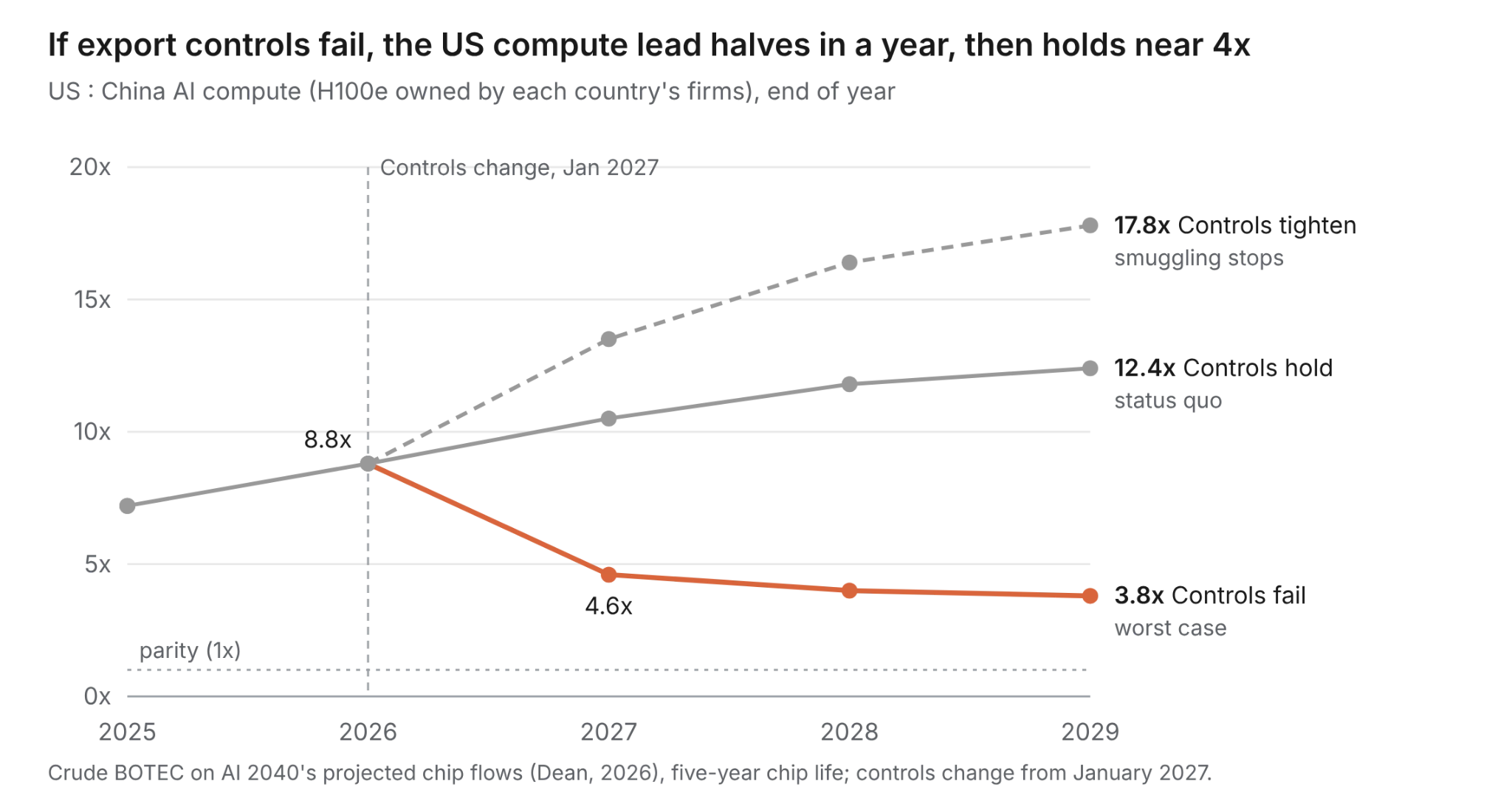
Figure 1. If we extrapolate based on current trends we see that if export controls fail, the US compute lead halves within a year.
Image
Based on this, export controls seem central to US leadership on AI. Although, notably, the US would still hold a significant advantage even if export controls fail, provided the US can continue to outbuy China in chips and continue building up data centers.
Combining both objection 1 and 2 we can also imagine a worst case scenario for the US compute advantage. Suppose US data center build-out reduces by 50% due to public backlash, China pools its compute to get serious about taking the lead on AI, and export controls fail. Then I estimate the US compute lead falls from about 9x at the end of 2026 to about 3x by the end of 2027 and 2x by 2029. A pooled China would have two to four times the compute of any single US lab and run research roughly 1.4–2x faster, so the US would have to pool in turn. If it did, and matched China’s R&D effort, it would still keep about 3–6x China’s compute for AI deployment assuming China put half its compute into R&D, and 12–24x if China put in 90%.10
So in summary, a pacing strategy that is not combined with preserving export controls and the continuation of US data center build out substantially increases the strategic risk of pacing for the US, since it potentially allows China to obviate much or all of the US compute advantage over the next few years.
Objection 3: What if the US accidentally loses its lead and China pulls ahead?
So far we have assumed the US stays roughly level with China or ahead. But what if the US miscalculates and China pulls ahead? The danger is greatest if China makes a breakthrough allowing it to leapfrog the US and if takeoff is very fast. Then a lead of weeks could conceivably compound into a decisive capability gap before the US compute edge has time to close it, and that prospect makes burning lead time riskier. How likely a fast takeoff is remains debated (see e.g. Davidson, Naam, TIME). Some think automating AI research could set off a fast, software-only intelligence explosion, potentially giving rise to superintelligence in a short span of time; others expect compute and data bottlenecks to keep progress gradual.
China might in principle try crippling cyberattacks on US labs and datacenters, but if open attacks crippled the US AI effort, the US has escalation options of its own, ultimately backstopped by nuclear deterrence, which superintelligence seems unlikely to break, at least not within the brief window its lead would give it.11 That pushes China toward covert sabotage, like perhaps poisoning US models, which would have to stop US catch-up while also staying deniable.
Hence, my guess is that the US could probably weather a brief Chinese AI lead. But it can’t be ruled out that a monumental leap in capability or development of a key unforeseen capability might still turn a short lead into a decisive one. The danger mostly waits in worlds where fast takeoff is possible and the US is in a pacing regime it can’t quickly adjust.

Conclusion
Pacing is meant to reduce the risk of losing control of AI, mitigating safety failures like this summer’s agent incidents or potentially more catastrophic failures but future AI capabilities including cyber, autonomous surveillance, and potentially even general superintelligence mean that the US falling behind on AI represents a risk to national security. We’ve reviewed the tradeoffs and I’ve argued that pacing looks affordable, since the major US advantage over China (and other states) is mostly one of compute, rather than calendar time.
First, pacing may not burn any lead at all and could be used to make US leadership more robust. Failed training runs, forced pauses and a cancelled release have now cost at least one frontier lab weeks to months, and a steadier pace may avoid many of these setbacks. Pacing also buys time to secure the labs, and a lead that can be copied overnight was never one the US could count on.
Second, a burned lead can probably be won back. US firms own about nine times China’s AI compute. Once AI does much of its own research, that compute edge gives a faster research loop which can be used to regain a spent lead. The same compute also gives the US a base AI deployment advantage of about 9x: far more AI manpower, both to strengthen its economy and for national defense. That in turn puts China in a bind, since keeping up with US research speed means leaving vastly less of its compute for AI deployment.
If the US compute lead weakens, US leverage for directing the pace of AI progress also weakens. If China pooled its compute while US labs stayed split, it might match one US lab on research speed, though the US would keep a manyfold edge in AI deployment and could pool in turn. If export controls failed, the US compute edge would fall below 5x within a year and settle near 4x. In a reasonable worst case scenario, with Chinese compute pooling and US data center build-out cut in half, the US compute lead drops to just 2x by 2029.
If China did leapfrog the US and pull ahead during a fast takeoff, the US has a good chance of being able to leverage its compute advantage to regain the lead, provided the window is brief. If China attempts to block this, for example by sabotaging US data centers, the US has a reliable option to respond.
In essence, my view is that the US can afford to spend much of its AI lead on safety and security if it needed to, as long as it protects its more impactful compute advantage, and retains the agility to speed up again if China gets close. The danger seems to lie mostly in double whammy scenarios, for example, where US slow down happens without export controls, or a fast takeoff meets a pacing regime the US can’t quickly rollback.
Recommendation: How should the US handle pacing if it wants to maintain its advantage?
- Consider capping each frontier lab’s R&D compute near or slightly above what the strongest Chinese counterpart can afford, for example at a fixed multiple such as 2x, while the rest can be put into safety research and AI deployment (e.g. employing AIs to shore up cyber vulnerabilities for key infrastructure and in broad usage throughout the economy). In this way, the US has strong prospects for holding or growing the current lead while also reducing loss of control risk. Because the cap is tied to China’s effort, it can also fall if China agrees to cap its own R&D spend and can be lifted quickly if China surges.
- Use government help to block foreign distillation, secure model weights, and harden labs and datacenters against cyberattack and sabotage.
- Keep permits and power for data centers moving and hold or tighten export controls, perhaps including on remote access to US chips abroad, so a paced US builds up its compute advantage which it can use as leverage to direct the pace of AI development.
- Invest in intelligence to track Chinese AI progress and closely monitor rates of misalignment in US frontier models. This is the key evidence that is needed to determine if the US needs to further adjust the pace of AI development, either investing more in research to preserve its lead or reducing research spend to invest in safety.
- Measure the rate of AI self-improvement, and note that if progress is very rapid both risks are exacerbated, i.e. burning a lead may be more costly and maintaining safety may be more difficult. This would then require more investment and oversight from the government or perhaps international coordination to further pace the frontier.
