The Saturation View
Citations
24th April 2026





0. Introduction
In Reasons and Persons, Parfit presented the challenge of developing “Theory X”: a theory of beneficence that dissolves the Mere Addition Paradox, avoiding the Repugnant Conclusion without facing other unacceptable conclusions.1
This note describes a new view in population axiology2 — the Saturation View, or Saturationism. I think it’s a plausible candidate for Theory X. The idea came out of work I’m doing with Christian Tarsney, whom I have to thank heavily for extensive back and forth and for exploring other related lines of inquiry. This draft is a first stab, to get the idea out there quickly; ultimately, we’ll turn this into a co-authored paper. Errors in this draft are my own.
As background motivation, I think there are fairly strong arguments for total utilitarianism as an axiology. On this view, one outcome is better than another iff the sum total of wellbeing is greater. But there are four sets of implications of the view3 that I find very unintuitive:
- The Very Repugnant Conclusion: Take any population A that consists of some number of extraordinarily well-off lives. For any number n and any negative welfare level z, there is some population Z, consisting of n lives at welfare z and a sufficiently large population of lives that are just barely worth living, such that Z is better than A.
- So, for example, a billion galaxies of bliss is worse than a billion billion galaxies of extreme suffering plus some very large number of lives that are barely worth living.
- Extreme Fanaticism. Consider a guarantee of some outcome B, where B is extremely good, some outcome Y, where Y is extremely bad, and some probability p. No matter how good B is, no matter how bad Y is, and no matter how small p is, there is some outcome C such that a probability p of C, and a probability (1-p) of Y, is better than the guarantee of B.
- So, for example, a billion galaxies of bliss for sure is worse than a 99.99999% chance of a billion billion galaxies of extreme suffering plus a 0.00001% chance of some sufficiently good outcome.4
- Infinitarian Issues. On the standard understanding of infinity, a population of an infinite number of beings at wellbeing +2 has the same total wellbeing as a population of an infinite number of beings at wellbeing +1; the former seems better than the latter, but the total view doesn’t have that implication. What’s more, the total wellbeing of a population of an infinite number of beings at wellbeing +2 and an infinite number of beings at wellbeing -1 is undefined; this is also true of the total wellbeing of a population of an infinite number of beings at wellbeing +1 and an infinite number of beings at wellbeing -2. But, again, the former seems better than the latter.
- Responses to these issues have been proposed,5 but they come with their own issues.
- Monoculture Recommendation. Take some fixed pot of resources that can be used to create lives. There is no population that can be created with those resources that is better than a population that consists only of qualitatively identical replicas of a small number of beings.
- And, in practice, it is likely that the best possible future, on many population axiologies, consists almost wholly of a monoculture. Some people have called this “tiling the universe with hedonium”.
The first three problems have been widely discussed in academic philosophy. The last has not. But it turns out that taking the last of these problems seriously ends up giving us the resources to avoid the first three, too. In particular, on one way (but not the only way) of accounting for the value of variety — the Saturation View — we can dissolve the Mere Addition Paradox and offer a principled response to the fanaticism and infinitarian problems, too.
I’m not claiming that you should believe Saturationism outright. In particular, its implications in some highly-negative worlds are hard to stomach, though I think similar implications are unavoidable for any view that avoids fanatical implications. But I believe that the four problems I list are the most major issues for the total view, and, in my view, Saturationism offers a considerably more plausible way of addressing these issues than any alternative to date.
This draft will:
- Present the monoculture problem, and give arguments for thinking that variety is intrinsically valuable.
- Give an informal statement of Saturationism, and a toy example of the view. The full formal statement is in the appendix.
- Show how accepting the value of variety dissolves the Mere Addition Paradox.
- Show how Saturationism avoids fanaticism in a particularly plausible way.
- Show how Saturationism avoids many problems in infinite-population settings.
- Show that Saturationism’s violation of separability (which almost any view other than totalism or the critical-level view will suffer from) is more limited and tamer than other non-separable axiologies.
- Discuss the difficulty of handling highly negative-value worlds. (The bulk of this draft focuses on worlds with positive value or only somewhat negative value.)
At the end, I’ll also very briefly discuss some further issues:
- How the view relates to Arrhenius’s other impossibility theorems.
- What “value-bearers” the view should treat as basic.
This is still draft work, and I expect the finished product to end up different in a number of ways. I mainly haven’t done citations, I expect there will be a number of errors I haven’t yet noticed, and I also expect that there are many challenges for the view that I haven’t yet identified.

1. The Monoculture Problem
1.1. Variety and Homogeneity
Consider two possible worlds.
Variety. A vast number of individuals all lead very good lives. Moreover, these individuals and the lives they lead are extraordinarily diverse—they exhibit a vast range of physical forms, personalities, interests, talents, and personal accomplishments. Despite their great number, no two individuals in this world are identical or even very much alike—or at least, having a near-duplicate is rare enough to itself be a notably distinctive characteristic. On the other hand, despite this diversity, inequality is relatively limited: all the lives in this world are very good, and the best lives are only modestly better than the worst.
Homogeneity. The same vast number of individuals exist as in Variety. But each of them is a qualitatively identical copy of the best-off individual in Variety. Every individual in Homogeneity has the same physical and psychological characteristics as every other, and experiences the same life history.
Intuitively, Variety is better than Homogeneity. A future containing only one life-type, repeated as many times as physics allows, feels impoverished.
Let’s encapsulate this into a principle:
Value of Variety: Other things equal, a world that contains a wide range of excellent lives is better than a world of the same size in which everyone lives the same excellent life.
1.2. Why standard axiologies prefer monoculture
I don’t know of an extant formal population axiology that captures the Value of Variety. This isn’t surprising: Homogeneity has higher total wellbeing, higher total critical-level-adjusted wellbeing, higher average wellbeing, and is more equal.
Going further, consider these two basic principles:
Pareto: If two worlds contain the same value-bearers, and every bearer is at least as well off in one world as in the other (with at least one strictly better off), then the former world is better.
Anonymity: If two worlds contain the same number of value-bearers at each welfare level, then they are equally good.6
Almost all prominent views of population ethics endorse these principles.7 But they entail that Homogeneity is better than Variety.
Start with Variety. Construct a new world, Variety*, which contains the same lives as Variety, but where each life’s welfare is raised to match the welfare level of the best life in Variety. By Pareto, Variety* is better than Variety.
Next observe that Variety* and Homogeneity have exactly the same welfare distribution: in each, every life sits at the “best-in-Variety” welfare level. By Anonymity, Variety* and Homogeneity are equally good. So, if we accept Pareto and Anonymity, we must conclude that Homogeneity is better than Variety.8
In general, whenever an axiology treats welfare levels as exhausting the evaluative information — a view known as formal welfarism — then it cannot represent the idea that diversity can constitutively contribute to a world’s value.9 It will either favour Homogeneity, or treat Variety and Homogeneity as incomparable.
But we can accept the value of variety while keeping to the spirit of welfarism, even if we reject formal welfarism. It can remain true, for example, that the value of a world supervenes on facts about welfare-subjects and nothing else.
1.3. The ideal future
To date, human societies have not faced clean choices like Variety vs Homogeneity. When institutions have tried to enforce uniformity, this has tended to reduce welfare at the same time.
Future technology may force sharper tradeoffs. The key development is the prospect of digital minds. If digital minds become possible, then in principle we could:
- search across designs to find unusually welfare-efficient minds;
- copy and rerun the same digital process with perfect fidelity at large scale;
- create enormous numbers of such minds.
Future civilisation would be able, if it wanted, to create endless replicas of qualitatively identical lives. If so, then given fixed resources, any formally welfarist view will recommend doing just that: essentially producing just one sort of life — whatever life maximises value per unit resource — as many times as possible. On almost all extant population axiologies, the best possible future is a monoculture of qualitatively identical but maximally efficient value-generators.10 I’ll call this the Monoculture Problem.
1.4. Arguments for Value of Variety
You might be sceptical of Value of Variety, for two reasons.
First, you could reinterpret the intuition as entirely instrumental. Perhaps variety matters only because it tends to support exploration, learning, and other welfare-promoting goods. If so, then our intuition that Variety is better than Homogeneity is a misfire, attributing intrinsic value to something that has only instrumental value.
Second, you could treat the intuition as a product of axiological uncertainty. We do not know what has value and so we should hedge: we should prefer a diverse future because that’s more likely to achieve some amount of what’s genuinely valuable. But, so the debunking argument goes, you should not expect the correct axiology to value variety intrinsically.
In my view, these arguments do not wholly debunk the intuition. It’s true that variety often has instrumental value, and that in the face of axiological uncertainty, we should sometimes hedge our bets.11 But, even taking this into account, it still seems to me that Homogeneity is worse than Variety.
In this section, I’ll give four arguments for this view.
1.4.1. The intuition pump
First, an intuition pump. Imagine some truly wonderful moment — of falling in love, or a flash of creative insight, or communing with the spiritual. Suppose that this moment is far more wonderful than anything that humanity has experienced to date: you or I would give up years of ordinary happy life just to experience such a peak of joy. But now suppose that this moment is just ever so slightly less good than some other moment that could be produced, with the same resources. So, instead, the world consists of a near-endless reliving of that other moment, and that first moment is never experienced at all.
To me, this feels like a tremendous loss. The world has omitted something wonderful that could have been created.
This sort of intuition doesn’t seem idiosyncratic to me. There’s a long tradition of thought according to which a world is better, other things equal, when it contains a richer range of good things. This came out in the “Principle of Plenitude”, suggested by Plato, Plotinus, Leibniz, and Lovejoy: the view that an omnibenevolent and omnipotent God would want to create a wide variety of different forms of worthwhile life, rather than just the single best sort of life.12
1.4.2. Intrapersonal variety
A second argument comes from thinking about what’s valuable within a life. Suppose that you could live for an extraordinary amount of time, and could choose any sort of life you wanted. Would you choose to relive, endlessly, the same maximally-good experience over and over again? Or would you instead choose to live through a wide variety of extremely-wonderful experiences?
I think most of us would clearly prefer the latter, and not merely because we would worry we’d get bored otherwise — we could stipulate that the maximally-good experience is one where one never feels bored. Rather, we have an intrinsic preference for variety.13
But if we think that variety within a life is desirable, then why not think that variety across lives is desirable, too? In fact, one important argument for taking a broadly utilitarian axiology is the “impartial observer” argument, made by C.I. Lewis, Hare, and, in a modified form, by myself in the opening of What We Owe The Future. The idea is that, when assessing what outcome is best, one should assess what would be best for you, if you were to live through all the lives in each outcome. This is a way of making precise the idea that ethics should be impartial.
Even if we don’t want to go so far as saying that the right tradeoffs across lives are the same as the right tradeoffs within a life, we might still think that this argument should have some weight. If variety is important within a life, then it’s at least somewhat important across lives, too.
1.4.3. Realisation-value
Many sorts of goods, such as art, species, and accomplishments, seem to get special value from being realised at all, and replicas of those goods seem to have diminishing marginal value. Intuitively, the first creation of Michelangelo’s David had more value than any of its replicas; those replicas are still valuable, but become less valuable the more of them there are. And, similarly, the value of the achievement from first reaching the South Pole seems greater than the value from the achievement of reaching it for the thousandth time.
There are two ways we can turn this into an argument for the value of variety. First, if we already think that, for many types of goods, there is special value in being realised at all, and diminishing impersonal value in replicas of those goods, then it seems natural to think the same might be true of lives or experiences.
Second, we could appeal to welfarists by arguing that the value of variety gives us a way of capturing this intuition without needing to invoke non-welfarist goods. If we think that variety of experiences contributes to a world’s overall value, then we can say, at least, that Michelangelo’s David had distinctive value that its replicas did not, because it enabled the realisation of a new type of experience. And we could make a similar argument for non-hedonist theories of welfare.
1.4.4. Benefits for axiology
The final argument for the value of variety is that, if we accept it, then we have a plausible way out of some of the problems that have plagued population axiology to date. The demonstration of this will take up the rest of this note.

2. Saturationism
This section will present an informal and slightly simplified statement of the view, a close analogy to illustrate the view, and a simplified toy version of the view. The full formal statement is in the appendix; technically-minded readers may wish to read it immediately after reading this section. However, the upshots will essentially all hold even just given the informal statement and the toy version of the view.
2.1. Informal statement
On most impartial axiologies, the best-possible future involves finding the best possible thing, and producing as much of it as we can. On the axiologies I explore now, the aim is to illuminate, as fully as we can, the landscape of possible positive conscious experiences. The view is motivated by the thought that impersonal value depends not only on how much welfare is realised, but also on how widely welfare is realised across the space of valuable forms. It grounds the value of variety in the realisation value of an experience, where the value of an experience is determined by both its wellbeing, and by how many very similar experiences also exist.
I’ll introduce the lumination family of population axiologies first, before specifying Saturationism, which is one member of that family. Lumination views evaluate worlds by considering not just how much total welfare exists, but how that welfare is distributed across the space of possible types of value-bearers.
Value-bearers are anything that can have a welfare level: lives, experiences, or other “welfare-events” like a particular preference-satisfaction. Different lumination views can treat different sorts of value-bearers as the basic units of value to be aggregated.
Value-bearers come in different types, defined by their qualitative characteristics. So, for example, for experiences these characteristics could include hedonic quality (joy / contentment / awe / spiritual-ness / affection / surprise / excitement / warmth / cosiness); complexity; nature (visual; auditory; tactile, etc); representational content; and, perhaps, duration and the temporal shape (rising or falling) of all the above. The welfare level of a value-bearer is not part of its type.14
There is a measure over the set of types, representing the “size” of each type, and a metric that measures distance between types (with more similar types being closer to each other), forming a landscape.
If a value-bearer exists, it contributes intensity, in proportion with its welfare level, to its type’s point in the landscape, and to the nearby neighbourhood. The extent to which a region on the landscape is illuminated is given by a saturation function: a concave function, bounded above, of the total intensity at that region. Intensity and illumination are calculated separately for positive welfare and negative welfare value-bearers.
A world’s total value is given by the integral of positive illumination across the landscape minus the integral of negative illumination across the landscape.
The concave relationship between how much welfare there is near a region and its illumination is what makes diversity valuable. A world with many different types of positive-welfare value-bearers will score higher than a world with the same total welfare concentrated among near-duplicates, since spreading value across dissimilar types means each value-bearer is contributing at a steeper part of the concave curve.
For now, we shouldn’t read too much, metaphysically, into types, measure, the distance metric, or the notion of illumination. As a default, we can think of these just as mathematical structures that generate the axiology we want, rather than stemming from some independent concepts. I treat it as an open question whether we can fully ground the mathematical structure in some independent notion, like the notion of similarity.
2.1.1. An Analogy
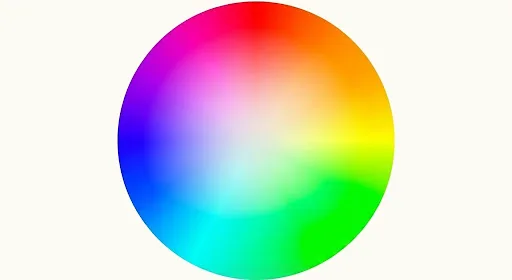
To illustrate the view, imagine the space of possible value-bearers as a colour wheel, lit from above by an array of tiny lights.
Image
In this analogy, a point’s hue—red, blue, green, and so on—corresponds to the qualitative type of value-bearer; each point on the wheel represents a possible type.
A populated world is a way of lighting this wheel. In an empty world, the wheel is dark. But, each time a value-bearer of some type comes into existence, it puts current into the light that’s pointed at its location, and nearby lights. This illuminates its location and nearby locations. But, as current increases, the increase in illumination gets progressively less. The first few instances of an experience in a region make it noticeably brighter, but as the region becomes well-represented, additional near-duplicates make progressively less difference. There is a certain magnitude of illumination that can never be produced at any point on the wheel, although the light can get arbitrarily close to producing that amount.
| Concept | Definition | Colour-wheel analogue |
|---|---|---|
| Type | A qualitative kind of value-bearer. | The hue of a point. |
| Metric | A definition of the distance between types. | Distances between points on the colour wheel. |
| Measure | The “size” of different subsets of types. | The sizes of areas of all different regions of the colour wheel. |
| Landscape | The space of types. | The whole colour wheel itself (though not necessarily illuminated). |
| Value-bearer | A token of a type; this could be an experience, a welfare-event, or a life. | The instantiation of current in a light. |
| Welfare level | A scalar attribute of a value-bearer. | The total amount of current added to a light and nearby lights by a value-bearer. |
| Intensity | The linear aggregation of welfare mass over a neighbourhood. | The total current flowing in an area of lights behind the wheel. |
| Illumination | The local value contribution of a neighbourhood; this is a concave function of intensity. | The brightness of an area on the wheel. |
Table 1. Glossary.
2.1.2. Saturationism’s commitments
Within the lumination family, I promote a particular position: the Saturation View, or Saturationism. This adds the following additional structure:
- Limited reach: No value-bearer illuminates the whole landscape.
- Varied reach: Some value-bearers illuminate a larger fraction of the landscape than other value-bearers do. In particular, more-than-barely-positive-welfare value-bearers can illuminate a wider area than barely-positive-welfare value-bearers can.15
- Low-welfare confinement: Barely-positive-welfare value-bearers occupy a small enough region of the landscape, or are sparse enough and illuminate only a small enough neighbourhood around them, or both, such that the total value that can be contributed by barely-positive-welfare value-bearers is strictly smaller than the total value that can be contributed by more-than-barely-positive-welfare value-bearers.
For now at least, we shouldn’t read too much into this structure. We can understand this structure as being motivated by the aim to produce an axiology with desirable properties (such as avoiding the repugnant conclusion), rather than coming from some independent notion of similarity, or being forced upon us from the nature of the value of variety. We’ll discuss this more in section 3.1.
Then, as defaults (but not as defining characteristics), the Saturation View I propose involves:
- Soft saturation: Until the number of very-similar instantiated value-bearers gets large, the function from intensity to illumination is approximately linear.
- Tiny reach: The instantiation of a type illuminates only a very small area around it, relative to the size of the overall space. (Note: this is a way in which the “Toy-Saturationism” I introduce in the next section does not mirror the full theory.)
- Positive/Negative symmetry: Positive-welfare and negative-welfare value-bearers are treated symmetrically, both in terms of how they contribute to illumination, and how those illumination profiles are aggregated.
- Experiential aggregation: The value-bearers which go into the theory are experiences (rather than lives or other welfare-events).
We’ll return to soft saturation and tiny reach in section 6 when discussing separability, positive/negative symmetry in section 7, and experiential aggregation in section 8.2.
2.2. A toy example
I give the fully-specified and continuous theory in the appendix. For now, we can illustrate the main points by presenting one concrete “toy” example of the Saturation View. This view is highly simplified; the point is to illustrate how such views escape from the impossibility theorems of population ethics. We’ll call this view Toy-Saturationism.
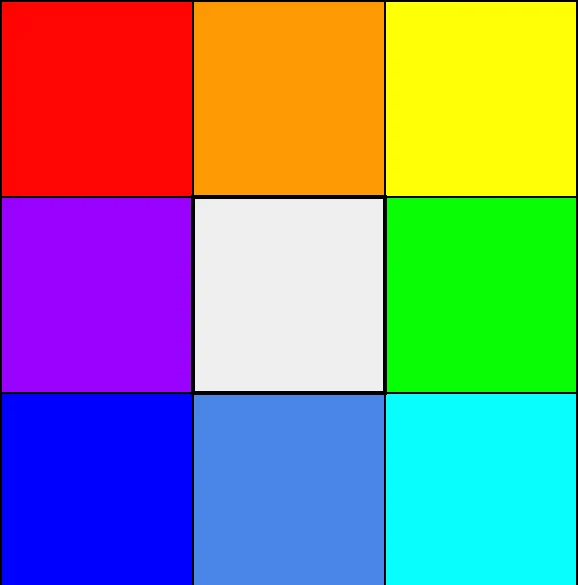
On this view, there are 9 possible types. 8 of those types are “high-magnitude welfare”; any value-bearers of those types have welfare . 1 of those types is “low-magnitude welfare”; any value-bearer of that type has . We represent this landscape with a simplified colour wheel, with the low-magnitude type as the central cell:
Image
Tokens of each of the high‑magnitude types contribute positive or negative intensity to any cells in their Moore neighbourhood (its own cell plus adjacent and diagonal cells). The amount of positive intensity a high-magnitude value-bearer contributes is proportional to the absolute value of its welfare, spread equally across these cells. Similarly for the amount of negative intensity. Low‑magnitude value-bearers contribute intensity to only their own cells.
The saturation function, which converts (positive or negative) intensity to (positive or negative) illumination, is . This is chosen to give us clean numbers in concrete examples: in particular, and . The overall value of the world is given by the sum of positive illumination, across all cells, minus the sum of negative illumination, across all cells.
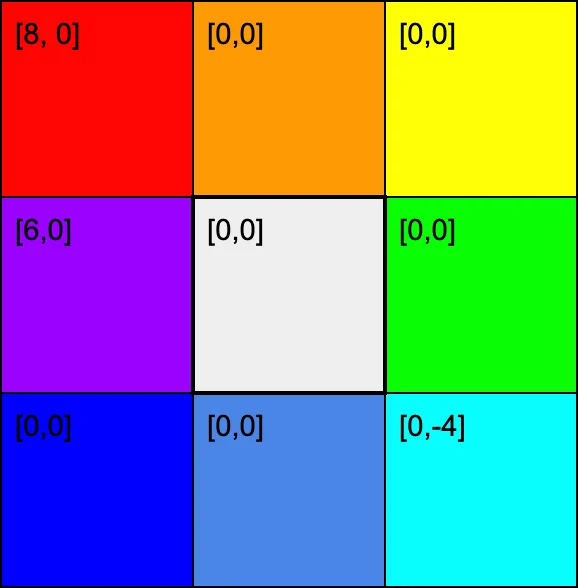
To illustrate, suppose the population consists of:〈(red, 3), (red, 5), (purple, 6), (turquoise, -4)〉. This would be the total positive and negative welfare per cell, with negative welfare on the right:
Image
This would be the intensity profile, with negative intensity on the right:
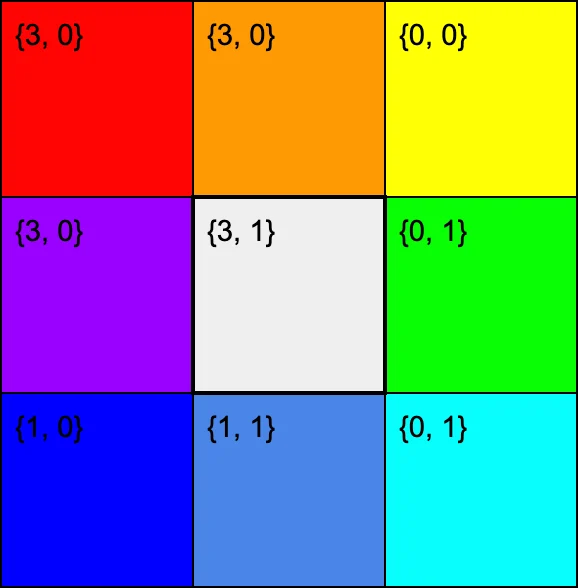
Image
This would be the illumination profile:
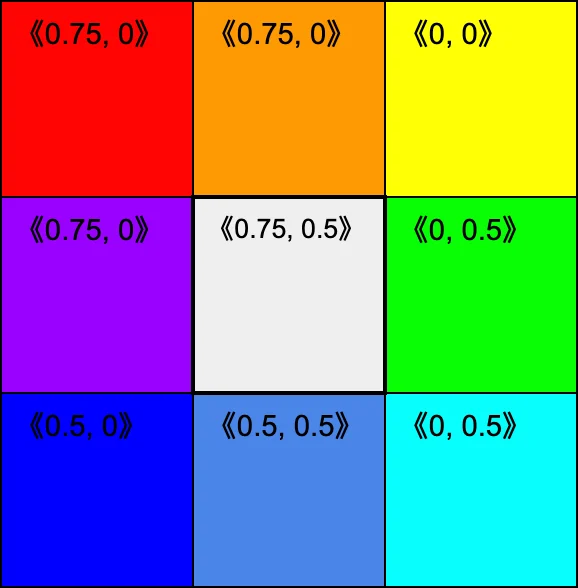
Image
And the overall value would be 2.16
On Toy-Saturationism, Variety is preferred to Homogeneity. In the Homogeneity world, there is a huge amount of total welfare, but it’s all concentrated in one cell. The upper bound of value of such a world is 6 (from the upper bound of the cell-type and up to 5 types adjacent to it). In the Variety world, the whole spectrum of experiences can be sampled from, and the upper bound of value from that world is 9.
This is an illustrative total welfare per cell in Homogeneity:
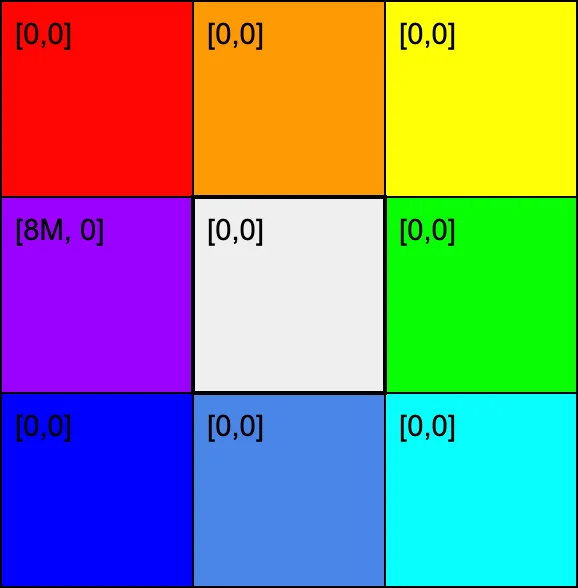
Image
Monoculture world. Total value is <6.
This is an illustrative total welfare per cell in Variety:
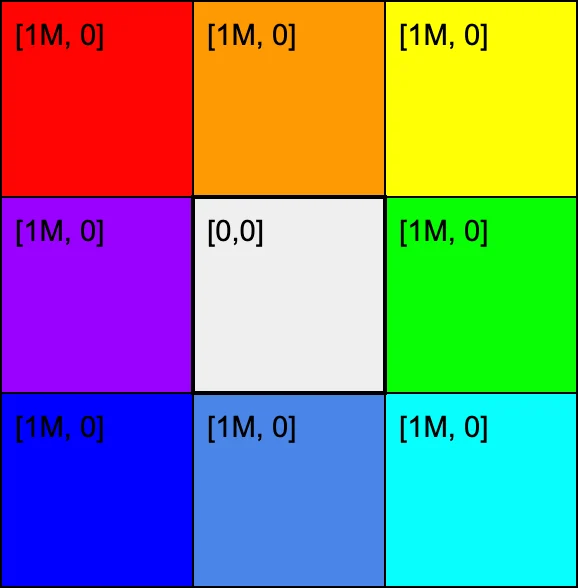
Image
Variety world. Total value can approach 9.
2.3. Variety-restricted principles
In our discussion of the Monoculture Problem, we saw that we must reject unrestricted Pareto and Anonymity. However, we can still accept restricted forms of such principles, which hold fixed the variety of a world. For example:
Fixed-Type Pareto: If all the value-bearers, and the types of those value-bearers, are the same in worlds Wx and Wy, and all value-bearers in Wx have at least as much welfare as they do in Wy, and if at least one value-bearer in Wx has strictly more welfare than it does in Wy, then Wx is better than Wy.
This principle follows immediately from the fact that the saturation function is strictly increasing.
Fixed-Type Anonymity: If Wx and Wy contain the same number of value-bearers, and the distribution of value-bearers’ welfare levels and types is the same in both worlds, then Wx and Wy are equally good.
This follows from the facts that, if two worlds have the same distribution of value-bearers’ welfare levels and types, then the intensity profile (and therefore illumination profile) is the same.
Given that variety is intrinsically valuable, it’s wholly to be expected that unrestricted Pareto and Anonymity principles would fail and need to be replaced with restricted variants. As an analogy: suppose we thought that the natural environment is of intrinsic value. If so, then unrestricted Pareto would fail: if the world were slightly better for everyone, but much worse for the natural environment, then the world could be worse overall, because the loss of value from environmental protection outweighs the welfare gain. Our “fixed-type” replacements are just specifying one part of the “ceteris paribus” clause that all Pareto and Anonymity principles should have.17

3. The Mere Addition Paradox
As is now familiar, the Mere Addition Paradox results from the conflict of three intuitively compelling principles (as well as transitivity of “better than” as a structural assumption):
Dominance Addition: If all value-bearers in Wx exist in Wy and have strictly greater welfare than they do in Wx, and Wy additionally contains some positive-welfare value-bearers, then Wy is at least as good as Wx.
Non-Anti-Egalitarianism: If Wx and Wy have the same population, but Wy has greater average (and thus total) welfare, and is more equal, then Wy is better than Wx.
Denial of the Repugnant Conclusion: There is some WA, consisting solely of high-welfare value-bearers, such that there is no world WZ consisting solely of very low-welfare value-bearers that is better.
However, if we want to accept the value of variety, both Dominance Addition and Non-Anti-Egalitarianism should be rejected: they fail in some cases where Wy has much less variety than Wx.
We can replace them with variety-restricted variants:
Fixed-Type Dominance Addition: If all value-bearers in Wx exist and have the same types as in Wy, and have strictly greater welfare in Wy than they do in Wx, and Wy additionally contains some positive-welfare value-bearers, then Wy is at least as good as Wx.
Fixed-Type Non-Anti-Egalitarianism: If all the value-bearers, and the types of those value-bearers, are the same in worlds Wx and Wy, and Wy has greater average (and thus total) welfare, and is more equal, then Wy is better than Wx.
Critically, these revised axioms do not entail the Repugnant Conclusion.
To see this, return to Toy-Saturationism. Consider A-world, which starts off with a very large population of each of the high-welfare types, each at wellbeing 10 (so welfare contribution at each coloured cell).
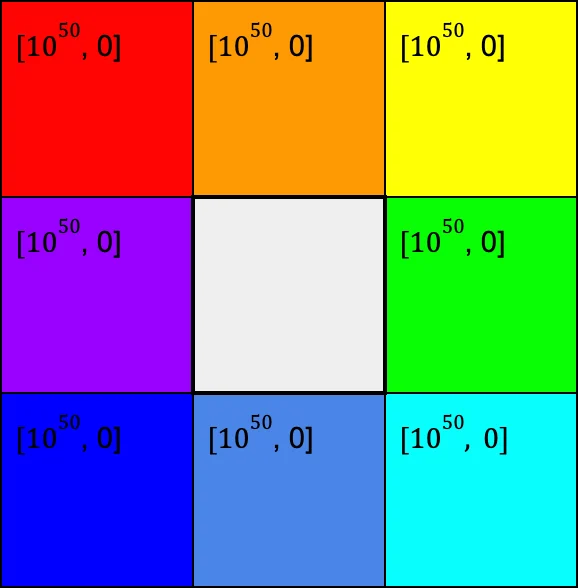
Image
A-world.
This world is already very close to the upper bound of value.
Via Fixed-Type Dominance Addition we increase the welfare of everyone in that world, and add an extraordinarily large population () of low-welfare value-bearers at welfare 0.001 (so welfare contribution at the grey cell):
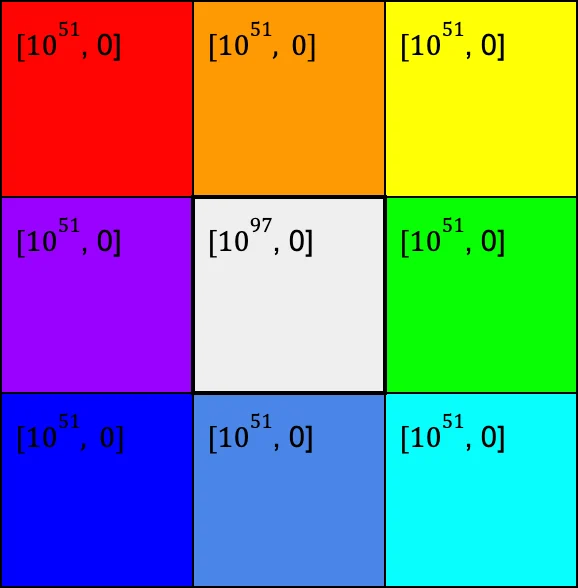
Image
This makes the world better, getting it even closer to the upper bound of value.
However, the next crucial step, following the Mere Addition Paradox, would be to employ Fixed-Type Non-Anti-Egalitarianism in order to find a better population that has greater total and average wellbeing, is more equal, and consists wholly of low-welfare value-bearers, while still being equally diverse. But that simply isn’t possible: to be equally diverse, the new population would need to include value-bearers of each of the high-welfare types present in the A-world—but then it would not consist wholly of low-welfare value-bearers. And if we restrict it to low-welfare types only, it can at most illuminate the (small) region of the landscape that low-welfare types can reach, which by Low-welfare confinement is strictly less valuable than what the A-world achieves. So the path to the Repugnant Conclusion is blocked.
What’s more, Toy-Saturationism satisfies Denial of the Repugnant Conclusion. The initial world is an A-world where there is no Z-world that consists only of barely-positive value-bearers that is better. So Toy-Saturationism satisfies all of Fixed-Type Dominance Addition, Fixed-Type Non-Anti-Egalitarianism and Denial of the Repugnant Conclusion.
So we have found a way out of the Mere Addition Paradox. Once we accept the value of variety, we have decisive reason to reject the principles that generate the Mere Addition Paradox. And, once we appropriately reformulate these principles, there is no longer any conflict between them.
What’s more, accepting the value of variety dissolves the Mere Addition Paradox in a way that, plausibly, correctly diagnoses why our reasoning in the Mere Addition Paradox went awry. We were mistakenly inclined to endorse unrestricted formulations of the underlying principles, without paying attention to diversity. (I think it’s no coincidence that Parfit’s canonical Repugnant world, consisting of lives that just listen to Muzak and eat potatoes, is very non-diverse.)
3.1. Defending Low-Welfare Confinement
The following feature of Saturationism was crucial for avoiding the Mere Addition Paradox:
- Low-welfare confinement: Barely-positive-welfare value-bearers occupy a small enough region of the landscape, or are sparse enough and illuminate only a small enough neighbourhood around them, or both, such that the total value that can be contributed by barely-positive-welfare value-bearers is strictly smaller than the total value that can be contributed by more-than-barely-positive-welfare value-bearers.
In Toy-Saturationism, Low-welfare confinement holds because barely-positive-welfare value-bearers can only occupy a small and concentrated region of the landscape, and because such value-bearers can only illuminate their own cell.
Neither of these features is necessary for Low-welfare confinement to hold.
Barely-positive value-bearers do not all need to be close to each other in the landscape; Low-welfare confinement could be true even if there are many distinct pockets of similar barely-positive value-bearers. And, on a theory with a larger colour-grid, barely-positive value-bearers could also illuminate areas outside of their own cell.
What is needed is just that: (i) low-welfare value-bearers in total only occupy a minority of type-space, and (ii) their reach (the area that they illuminate at all), is sufficiently small.
(One could generalise this latter idea, such that the total area that a value-bearer illuminates is dependent on the welfare of that value-bearer. The formal statement of Saturationism will also introduce the idea of variable value-caps on regions, which give further means by which Low-welfare confinement could be justified.)
One might worry that, even if each individual barely-positive type illuminates only a small region, there could be infinitely many such types, scattered across the landscape, and an arbitrarily large Z-world could populate all of them, achieving unbounded total value. But Low-welfare confinement constrains the total measure of the region that barely-positive value-bearers can illuminate, not just the number of types. This is described more precisely in the appendix.
Low-welfare confinement is defensible in two different ways. The first defence relies on the idea that types, distance, measure, reach, etc, are all themselves axiological notions. They serve just to structure a plausible axiology; they don’t refer to any concepts that are metaphysically independent of the axiology we’re invoking. The structure is a way of capturing the value of variety, but only of “variety worth having”; and what counts as variety worth having, and how it contributes to overall value, should be determined by our carefully-considered axiological judgements.
With that in mind, the justification for Low-welfare confinement is reflective equilibrium among our considered moral judgements, including the repugnance of the Repugnant Conclusion. Our intuition that the Repugnant Conclusion is repugnant shows that whatever diversity there is in any Z world is not worth having compared to the diversity in the A world.
What’s more, this argument could be made without appeal to the Repugnant Conclusion directly. Return to the intuitions and arguments that motivated Value of Variety, and imagine a possible future that only consisted of barely-valuable bearers. Doesn’t such a future seem like it involves a terrible loss, not merely from a welfarist perspective, but also because it doesn’t involve any bearers that are truly wonderful? Such that a future like that is very far from a best-possible future? If so, then, in the Saturationist framework, barely-valuable bearers cannot illuminate the whole space, no matter how many of them there are.
The second approach is to argue that Low-welfare confinement is plausible even if we invoke some independent notion of similarity. This argument is strongest if the value-bearers we are aggregating are “welfare-events” (e.g. experiences, or satisfied preferences, or whatever makes up lifetime wellbeing) rather than “lifetime wellbeing”.
One argument is that the range of “barely positive” welfare-levels (0 to ) is tiny compared to the range of welfare levels outside of that range, on any intuitively reasonable measure over welfare-levels. So if the amount of variety among value-bearers is even very approximately proportional to the volume of value-space they take up, then the variety among all better-than-barely-positive value-bearers is much greater than the variety among barely-positive value-bearers.18
What’s more, plausibly there are certain types of value-bearers that do not exist in low-welfare forms. Consider experiences: although the experience of riding my bike can be arbitrarily close to 0-welfare; the experience of creative insight, or appreciation of the sublime, or orgasm, cannot. In contrast, I don’t see a case for thinking that there are lots of types of experiences that only exist in the barely-positive range. This thought gets more compelling if the basic value-bearers are atomic experiences, rather than composite experiences (where, for example, having a creative insight while also having a headache is two atomic experiences forming one composite experience).
The first approach to defending Low-welfare confinement could apply whatever the value-bearers are — whether lives or welfare-events. This second approach is weaker if we’re aggregating lifetime wellbeing rather than welfare-events, because, plausibly, a life can consist of some extremely wonderful positive experience, and some truly horrible negative experience, and net out to be barely worth living; Parfit calls these “rollercoaster” lives. Barely positive lives can therefore involve the full range of experiences.
Given this, we can take one of two paths forward. First, we could apply the Saturation View only to welfare-events. This allows us to rely on the second category of argument for Low-welfare confinement, but would mean that the view accepts the variant of the Repugnant Conclusion in which the Z-world consists of rollercoaster lives. This approach might be particularly attractive if one anyway has what Broome calls a “disunifying metaphysics” and is sceptical that there are axiologically-relevant facts about personal identity. Alternatively, it might be attractive if one doesn't find the rollercoaster variant of the Repugnant Conclusion repugnant.
Second, one could rely more heavily on the first category of argument, and deny that even rollercoaster lives can be sufficiently diverse, in the sense of diversity that goes into the Saturation View. I see both of these approaches as reasonable, although in section 8.2 we will see an additional argument for focusing on welfare-events.
4. Fanaticism
The facts that Saturationism can avoid the Monoculture problem and dissolve the Mere Addition Paradox are major arguments in its favour. A third argument is that it gives a principled way of responding to the problem that many axiologies, when combined with certain standard and plausible decision-theoretic principles, yield the following implausible implication:
- Fanaticism. Consider a guarantee of some outcome B, where B is extremely good, and some probability p. No matter how good B is, and no matter how small p is, there is some outcome C such that a probability p of C, and a probability (1-p) of nothing, is better than the guarantee of B.
Some axiologies, such as totalism, also yield the even more implausible implication:
- Extreme Fanaticism. Consider a guarantee of some outcome B, where B is extremely good, some outcome Y, where Y is extremely bad, and some probability p. No matter how good B is, no matter how bad Y is, and no matter how small p is, there is some outcome C such that a probability p of C, and a probability (1-p) of Y, is better than the guarantee of B.
In my description of Saturationism, I said that there’s a design choice of how to handle negative value, both in terms of how to handle variety, and how it should weigh against positive value. This becomes relevant for the fanaticism issue, and will be discussed later. As the default, I will treat positive and negative value symmetrically for now.
Saturationism does not entail Fanaticism. This is because total achievable value is bounded above and below: there’s an upper limit on how good things can get, such that outcomes can approach this limit ever-more-closely, but cannot hit it; similarly for how bad things can get. But if V is bounded by and then no event of probability p can change expected value by more than . Stipulating that the value of nothing is 0, the expected value of a guarantee of B is greater than the expected value of any gamble that gives a probability p of C, and a probability (1-p) of nothing, as long as p is less than .
The boundedness of Saturationism follows from the facts that: (i) the saturation function has an upper bound, and (ii) total cap mass is finite (which holds if either type-space is finite or the “cap density” over type-space decays fast enough to be integrable (see the appendix). (As with Low-welfare confinement, we have a choice about whether to argue for this structure on independent grounds, or defend it on the basis that it results in an intuitively attractive theory.)
Saturationism’s non-fanaticism has some nice properties. The concavity of value is smooth; it doesn’t posit lexicality or discontinuities, and it doesn’t violate the standard axioms of expected utility theory — unlike, for example, Nicolausian discounting, or variants of that idea, which ignore sufficiently small probabilities.
What’s more, on Saturationism the boundedness has at least some independent motivation: there is an upper bound on impersonal value because there is only so much evaluative terrain to be illuminated. And it follows from intuitions we have about variety — in particular, about the steep diminishing marginal value of additional replicas, such that for some high-welfare and highly varied A-world, there is no population of replicas of some value-bearer b that is better than it, even if b is itself high-welfare.19
For that reason, Saturationism can deal in a more principled way with the “spectrum” argument in favour of Fanaticism: Take a guarantee of some very good outcome B. Then consider a prospect with a 0.999 probability of 10 times as much welfare as in B, and 0.001 probability of nothing. That seems better than the guarantee. Then consider a prospect with a probability of as much welfare as in B, and a () probability of nothing. Again, that seems better. Then keep repeating this, until you have a prospect with only a probability of times as much welfare as in B. The spectrum argument seems powerful because, in general at least, the second prospect seems clearly better than the first, and then it seems arbitrary not to take any of the subsequent trades.
However, on Saturationism you do have a principled stopping point: it’s when the space of valuable possibilities, in the good outcome, would be so saturated that you could only increase total wellbeing tenfold by adding very similar value-bearers that already exist in abundance. At some point, the additional gains from even-more similar value-bearers are of such limited value that it’s not worth the gamble.

5. Infinite ethics
5.1. The problem for totalism
On the total view, the value of a world is the sum of welfare across all value-bearers. When there are infinitely many value-bearers, this sum may diverge: it may be positively infinite, negatively infinite, or undefined. This creates several well-known difficulties.20
First, infinitarian paralysis: if the world already contains infinite positive wellbeing, then any finite action an agent can take adds a finite quantity of wellbeing to ∞ wellbeing. The world’s overall quantity of wellbeing, and therefore value, is unchanged. So the total view cannot distinguish between ending world hunger and causing a famine— it loses all discriminating power.
Second, infinite positive and negative wellbeing: a world with infinitely much positive welfare and infinitely much negative welfare has no well-defined total.
Third, Pascalian fanaticism: on the total view, any gamble with any positive probability (no matter how small) of infinite positive wellbeing has greater expected value than any certainty of a finite outcome (no matter how good), because ∞ times any positive probability is still ∞.
Various responses have been proposed.21 The leading approaches include: expansionism,22 which evaluates infinite worlds by the limit of partial sums within expanding regions; spatiotemporal Cesàro averaging;23 and hyperreal-valued theories.24
Each has significant limitations. Expansionism requires a privileged centre, an expanding sequence can fail to discriminate between many pairs of worlds, it yields only ordinal rankings, and is unattractively sensitive to the spatiotemporal distribution of value: moving identical utopian planets an inch closer together can be good enough to justify any finite addition of dystopias, because this would increase welfare density within any expanding region. Cesàro averaging faces similar problems of spatiotemporal sensitivity and reference-frame dependence; Pivato argues this can be resolved by requiring Lorentz invariance, but the resulting view still does not yield cardinal values. The hyperreal approach, too, faces problems of spatiotemporal structure like the earlier “moving planets together” problem, and either involves substantial indeterminacy or involves dependence on a choice of ultrafilter.
5.2. How Saturationism helps
Saturationism can avoid most of these difficulties.25
Well-defined value for all worlds. Because value is bounded above and below, every world receives a well-defined value in a bounded interval. This includes both worlds with infinite value-bearers, and worlds where individual value-bearers have infinite positive or negative value. So there is no problem of widespread indeterminacy, for example from infinite positive and negative wellbeing.
What’s more, Saturationism gives the same kind of answer—a bounded real number—whether the population turns out to be finite or infinite. There is no discontinuity: as a population grows from very large to infinite, world value approaches the saturation limit asymptotically, with no abrupt jump to undefinedness.
Cardinal values and non-Pascalianism. Moreover, Saturationism assigns cardinal values to all worlds. Standard expected-value reasoning therefore applies without modification. And, since world value is bounded above and below, the same structure that blocks ordinary fanaticism blocks its Pascalian infinite counterpart: there are some finite outcomes that are sufficiently good that their expected value is greater than a minuscule probability of any infinitely high-wellbeing world.
Discriminating power. Saturationism discriminates between many different worlds that contain infinite wellbeing. Compare Infinite Monoculture — which only contains an infinite number of positive-welfare copies of the same type — with Infinite Monoculture + Finite Rainbow, which also includes a finite number of positive-welfare lives of very different types (outside the reach of the type of the infinite lives). On the total view with the extended reals, these worlds are equally good. On Saturationism, the latter is strictly better.
This means that living in an infinite world need not paralyse us. Finite changes to an infinite world can make the world better.
5.3. A choice-point: extended reals vs. hyperreals for intensity
There is an issue for the simplest version of Saturationism which uses the extended reals: if a region already has infinite intensity, then adding one more bearer of the same type in that region makes no difference to the value of the world. We have two ways to respond.
One response is simply to accept the implication. The thought might be that what matters is coverage of the landscape, and once coverage is complete in a region, additional value-bearers should not make any further difference. On this view, the concept of a “perfect world”—one where the landscape is fully saturated—makes sense.
But this position does imply failures of monotonicity principles such as:
Positive Expansion: Adding a positive-welfare value-bearer to a world makes that world strictly better.
And it means that the view still suffers from a mitigated form of the paralysis issue, because no positive change can affect the value of worlds in which the whole landscape is fully saturated. This may well be the world we live in; and even if it’s not, it’s hard to see how we would be able to illuminate some part of the landscape that no other civilisation in the infinite universe has illuminated.
The alternative response to this issue is to represent intensity using the hyperreals rather than the extended reals. Then even a region with infinite intensity retains infinitesimal headroom above it, so adding one more bearer increases illumination by an infinitesimal amount. This preserves Positive Expansion while retaining all the central advantages described above. Following Ord’s suggested “middle path”, one can treat comparisons as determinate when they are invariant across all choices of ultrafilter, and indeterminate otherwise.
This inherits some of the problems that face the hyperreal approach, but in a highly mitigated form. On hyperreal totalism, the value of a world is itself a hyperreal number, and the ultrafilter determines the macro-level ranking of worlds: whether one infinite world is better or worse than another, or whether they are comparable at all. Indeterminacy, or sensitivity to a choice of ultrafilter, is widespread.
In contrast, on hyperreal Saturationism, each world has an ordinary real-valued score. Hyperreals enter only to break ties — determining whether adding one more bearer to a fully saturated region counts as an infinitesimal improvement or not. The ultrafilter dependence is thereby quarantined: the macro-level ranking is determinate and ultrafilter-independent; only the infinitesimal fine structure, which breaks ties when the real-valued score is the same, is not.
I lean towards preferring the hyperreal version, but the advantages of Saturationism canvassed in section 5.2 hold either way.
5.4. Comparison with hyperreal totalism
We can contrast the Saturation View with hyperreal totalism, developed recently by Toby Ord. This assigns fine-grained hyperreal values to divergent sums, so that ω ≠ 2ω, and every finite change to a world produces a distinct hyperreal value. This approach has a lot going for it. It yields Strong Pareto, avoids infinite positive and negative wellbeing guaranteeing indeterminacy, and, when determinate, yields cardinal value. But Saturationism has a few significant advantages over this approach.
First, comparisons between hyperreal-valued worlds often depend on a choice of ultrafilter, which seems arbitrary. On Ord’s “middle path”, comparisons are determinate only when they hold across all choices of ultrafilter. But then the resulting view suffers from significant indeterminacy.
For example, compare two worlds:
- World 1 contains generations with welfare +1, −2, +3, −4, +5, −6, and so on: alternating periods of growing flourishing and growing suffering.
- World 2 contains only positive-welfare lives. Most individuals have lives at welfare +0.1, but a subpopulation is even better off. The k-th better-off individual has wellbeing +k, and the gap between the better-off individuals doubles each time.
On the hyperreal approach, the value of world 1 is either +ω/2 (an enormously large positive value) or −ω/2 (an enormously large negative value), depending on the ultrafilter. So it’s extremely indeterminate what value it has. This is odd in and of itself — one would expect the value of such a world to be close to zero.26
But it also means the comparison with world 2 is wrong. World 2 consists of only positive wellbeing lives, with no offsetting negative-wellbeing lives. And, like in world 1, for any positive wellbeing level, there are an infinite number of lives that are higher than that level. So world 2 seems determinately better than world 1. But, on the hyperreal approach, the value of world 2 is approximately +ω/10. So whether world 1 or 2 is better depends on the choice of ultrafilter. So, on the hyperreal approach, neither world is better than the other.
In contrast, Saturationism is not dependent on choice of ultrafilter in this way, and, holding positive footprint fixed, captures the intuitive implication that world 2 is better than world 1.
Second, Saturationism is able to deal with worlds where individual value-bearers have infinite wellbeing. As currently formulated, hyperreal totalism does not handle such cases well. A world with infinite locations of infinite positive wellbeing would be no worse than a world with just one location of infinite positive wellbeing. And, if a world has infinite locations with infinite positive wellbeing and one location with infinite negative wellbeing, then, on hyperreal totalism, the overall value is undefined.
Third, Saturationism is not sensitive to the spatiotemporal order of value-bearers. On hyperreal totalism, the sum total of welfare must be taken in some order, and different orderings of a conditionally convergent series can yield different hyperreal values. Some spatiotemporal structure is needed to fix the ordering. This means that a world can be made better by both adding enormous quantities of suffering and moving all the planets slightly closer to each other, which seems very implausible.
Similarly, unlike Saturationism, hyperreal totalism requires a choice of a privileged origin in order to enumerate value-bearers; this choice can make a major difference to how worlds are compared. But this choice seems ethically arbitrary.
More broadly, a major advantage of Saturationism over alternative approaches is that its treatment of infinite ethics is not ad hoc, invoking some structure (like spatiotemporal structure) in order to deal with the infinite case. Rather, it falls out of the same core machinery that was introduced to handle monoculture, the Repugnant Conclusion, and fanaticism.

6. Separability
An axiology is separable if adding the same disjoint background population doesn’t change the ranking of two populations. That is, take populations P, P’, where Q is disjoint from both and . For all such P, P′, and Q, V(P) > V(P′) iff V(P ∪ Q) > V(P′ ∪ Q). Intuitively: if the extra people in Q are the same in both options, they should be irrelevant to the comparison.
Violations of separability are often taken to be a problem. Suppose that we can create one of two new populations in the future. Is it really relevant to that choice what the lives of the ancient Egyptians were like? Or how many aliens there are, and how well-off they are? On non-separable views, the answer is typically yes: facts about wholly “unaffected” people can change what we ought to do. That can seem strange.
Blackorby, Bossert and Donaldson have shown that the only population axiologies that satisfy some standard technical axioms27 are critical-level views (with totalism as the special case where the critical level is 0). So, if you want to reject these views, then you have to reject separability.
Saturationism is, therefore, a non-separable axiology. However, this is a feature of the view, not a bug. The intuition that Variety is better than Homogeneity is fundamentally an intuition that the correct axiology is non-separable. What it means for an outcome to be varied is for some value-bearers to be different to each other. So respecting the Value of Variety makes non-separability unavoidable. If we accept the Value of Variety intuition, then separability has to go, and along with it any axiology that satisfies separability.
Moreover, the way that Saturationism violates separability is much tamer, and less unintuitive, than other non-separable population axiologies.
First, Saturationism satisfies a more limited separability principle. In our toy theory, we’ll define the footprint of a world as the set of all cells that the world illuminates at all. That allows us to define the following principle, which Toy-Saturationism satisfies:
Disjoint-Footprint Separability: If population Q has a wholly non-overlapping footprint with populations P and P’, then for all P, P′, Q, V(P) > V(P′) iff V(P ∪ Q) > V(P′ ∪ Q).
It even satisfies a stronger additivity principle:
Disjoint-Footprint Additivity: If populations P and Q have wholly non‑overlapping footprints, then V(P ∪ Q) = V(P) + V(Q).
Contrast this with, for example, Ng’s variable value view.28 On Ng’s view, there are almost no populations and such that V(P ∪ Q) = V(P) + V(Q); the exceptions are edge cases (e.g. when one population is empty).
In fact, in section 2.1.2, I suggested that the Saturation View should satisfy Tiny reach — that instantiation of a type illuminates only a very small area around it, relative to the size of the overall space. If so, then it will be quite generally true that the value of two populations is equal to their sum, because it is typically the case that any two small populations’ footprints don’t overlap. It’s only when populations get large that the chance that their footprints overlap becomes meaningful, and those are just the sorts of situations where our variety-related intuitions kick in.
What’s more, Tiny reach seems independently motivated by considering what it would take to produce an outcome that comes arbitrarily close to the upper bound of value. Intuitively, it would require a lot of diversity — trillions of trillions of different forms of life or experience. If so, then the maximum footprint that you could get from a world consisting of any one type must be very small. (This is a way in which our Toy-Saturationism does not accurately represent the full theory; instead, we would need a grid with at least trillions of trillions of cells.)
Tiny reach helps in particular with some of the classic ways of putting pressure on non-separable views. Let’s start with aliens. If alien value-bearers do not illuminate the same areas that human and post-human value-bearers do, then the nature of alien civilisations does not affect how we should evaluate different futures available to us.
Similarly, if Egyptian value-bearers do not illuminate the same areas that the value-bearers that we might create would, then that should not affect our evaluations, either. Moreover, if we were considering whether to create value-bearers that are very similar to those that existed in ancient Egypt, then the “Egyptology” objection no longer seems so pressing. Suppose, for example, that perfect replicas of an Egyptian society had already been created trillions of times in our past. It would seem quite natural to think that this is relevant information, and it’s more valuable to create some novel form of life instead.29
A second way in which Saturationism’s violation of separability is limited is if we endorse what I called Soft saturation: that, until the number of very-similar instantiated value-bearers gets large, the saturation function is approximately linear.
Approximate linearity of the saturation function can come from two sources. The first is if the number of instantiations of a type (or of a similar type) required to get meaningfully close to the saturation function’s upper bound is very large. If so, then for small changes, the function will be locally linear. For example, if it takes trillions of trillions of trillions of replicas of some type to get more than halfway to the upper bound on value for replicas of that type, then in a “normal” world, with fewer than trillions of value-bearers, Saturationism would aggregate value approximately linearly.
The second way to get approximate linearity is via the shape of the saturation function. The saturation function could be approximately linear until it gets close to the upper bound. An example would be , where higher k makes the function approximately linear for longer. With k = 10, then even at halfway to the upper bound, the function is still linear to within about one part in 10,000.
Both of these approaches fit with my intuitions about aggregating replicas, or value-bearers of very similar types. And, on either or both approaches, and especially when combined with Tiny reach, then for small and/or varied populations, Saturationism would be separable, approximating totalism. The thought could be that totalism gets axiology basically right for “normal” situations, and it’s just in unusual situations that the totalist approximation fails, in the same way that Newtonian mechanics gets physics basically right for normal situations, and it’s just in unusual situations that the Newtonian approximation fails.
I’ll end this section with a more speculative thought. Derek Parfit’s view of “what matters” in survival was whether an individual is R-related to you. The conditions for R-relatedness he proposed involved psychological continuity or connectedness through a causal chain. But suppose we drop the causal requirement,30 perhaps on the grounds that, even if there were a glitch in the teletransporter that severed the causal connection and yet, by fluke, a perfect psychological copy of you emerged from the other side, intuitively it would still be you. If so, then I am R-connected to lives far away in the universe. So, perhaps, the maximum footprint of my life is the set of lives that I would be R-connected to, if they were to exist.
It is much less controversial to claim that separability does not hold within a life. If so, then it should be less controversial to claim that separability does not hold within this set, either. On this view, the value-bearers between which separability doesn’t hold are, in some way, to some degree, part of the same life.
This thought would also give a more direct argument from the desirability of intrapersonal variety to the desirability of interpersonal variety, which we discussed in section 1.4.2.

7. Negative value
We have various options on how Saturationism should deal with negative value. Here are some of them:31
- Saturationism only applies to positive value. Negative value aggregates linearly, in line with the total view.
- Saturationism applies to both positive and negative value. The magnitude of the lower bound on value is the same as the magnitude of the upper bound on value.
- Saturationism applies to both positive and negative value. The magnitude of the lower bound on value is greater than the magnitude of the upper bound on value.
Each has its issues. Let’s take the first option.
First, I at least personally get the intuition that a variety of bads makes an outcome worse. Consider two outcomes:
Diverse Hell: Satan creates an enormous number of suffering lives, each of whom experiences their own distinctive form of torture. They all have terrible lives, though the depth of suffering varies slightly from person to person.
Uniform Hell: Satan creates the same number of people as in “Diverse Hell”, but this population consists only of perfect copies of the worst-off life in “Diverse Hell”.
If Diverse Hell is worse than Uniform Hell, then this motivates options 2 or 3.
My intuition is that Diverse Hell is worse than Uniform Hell, but I accept that the intuition here is less clear than it is in the positive case. The intuition receives mixed support from considering classical depictions of hell (e.g. Dante’s Inferno, Buddhist Naraka, Greek Tartarus, Islamic Jahannam). These overwhelmingly feature variety rather than uniformity in suffering; however, this is confounded to an extent by the idea that punishments need to be varied to fit the sin, and in some cases (e.g. Sisyphus eternally rolling a boulder up a hill), the monotony and repetition is part of what makes the punishment seem terrifying.
A second issue with linearity for negative value is that it makes the view extremely negative-leaning, at least in some worlds. This is because value is bounded above, but not bounded below. So, in some worlds, the amount of badness of a worst-case outcome could be astronomically larger than the goodness of a best-case outcome. If maximising expected value, with reasonable credences, one should be fanatically devoted to preventing the chance of worst-case outcomes, even if the probability of those outcomes is tiny.
The third and most major issue with linearity for negative value is that it brings back fanaticism, and a variant of the Very Repugnant Conclusion. The fanatical implication is this: Consider an outcome with an arbitrarily enormous quantity of suffering. And consider any arbitrarily minuscule probability. Given totalism about negative value, there is some other outcome with a sufficiently large quantity of suffering that you should prefer the guarantee of the enormous quantity of suffering over a gamble that gives you the minuscule probability of the even-greater amount of suffering and a blissful utopian future otherwise (i.e. with near-certainty).
The variant of the Very Repugnant Conclusion is this.32 Consider an outcome with an arbitrarily enormous quantity of suffering. Then there is some other outcome consisting of a much larger quantity of blissful lives, and some sufficiently large number of lives that are barely negative, which is worse.
Moreover, we can combine these problems. In example form:
Fanatical Reverse Very Repugnant Conclusion. A guarantee of a billion galaxies of suffering is better than a guarantee of a billion billion galaxies of bliss plus a one-in-Graham’s-number chance of some very large number of lives that are barely negative (and therefore almost worth living).
This is a pretty undesirable implication.
Moreover, if the view entails these forms of fanaticism and the Repugnant Conclusion, then it undermines much of the motivation for Saturationism in the first place.
The alternative approach is to treat negative value with the same Saturationist structure. If we do so, it’s an open question whether option 2 or 3 is preferable. It’s natural to think that the lower bound on badness is of greater magnitude than the upper bound of goodness. If so, then option 3 is preferable. However, this does commit one to a weak form of lexical-threshold negative utilitarianism:33 there is some sufficiently large and diverse population of suffering lives that cannot be counterbalanced by any population of good lives, no matter how well off and diverse they are. It’s not clear to me whether this is a problem or a desirable implication.
What I see as the main problem for extending Saturationism to the negative domain is this: Take any arbitrarily large quantity of suffering. There are some situations in which it’s better to add that quantity of suffering to the world and some barely-positive life rather than to do nothing.34 This is because, on this approach, suffering saturates: as long as there is enough suffering already, then additional sufficiently-similar suffering has tiny marginal disvalue. Call this the “cheap suffering” problem.
Unfortunately, similarly-bad implications will follow for any view that is bounded below and combined with expected value maximisation under uncertainty. Consider the following choice: You’re 50/50 unsure on whether you’re in an otherwise empty universe, or if there’s an enormous amount of suffering already. You have the option to do nothing, or to add a barely-positive life if you are in an empty universe, and add 1 trillion suffering lives if you’re in the universe that already has enormous suffering. Given lower-boundedness, you should take that option rather than nothing. But that’s no less implausible than what Saturationism entails.
We are forced to choose between fanaticism, expected value maximisation, and this “cheap suffering” problem. We can mitigate the problem to some extent by endorsing Soft Saturationism, and making the lower bound of disvalue astronomical in magnitude. This means that “cheap suffering” situations are highly unusual, involving astronomical numbers of near-copies, and where our intuitions may be unreliable. But the in-principle problem will still be there.
I see the difficulties around how to handle highly-negative value to be the strongest argument against Saturationism.
But, at least if you are deeply troubled by examples like the Fanatical Reverse Very Repugnant Conclusion, I don’t see any alternative for population axiology in the negative domain that avoids some extremely implausible-seeming implications.
8. Additional issues
This final section will discuss, even more briefly, some extant issues for Saturationism. Content in this section is even more likely to contain errors than the rest of this note.
8.1. Arrhenius’s other impossibility theorems
The Mere Addition Paradox is one impossibility result in population ethics. But it’s not the only one. Gustaf Arrhenius has proved a number of others. These results replace the Repugnant Conclusion with one of the following:
Very Repugnant Conclusion: no matter how good a given excellent population is, and no matter how many extremely suffering lives are added, there is some sufficiently large number of barely-good lives such that the suffering-lives-plus-barely-good world is better.
Repugnant Addition: in some background context, no matter how many excellent lives you add, you can make the world even better by instead adding a large enough number of barely-good lives.
Very Repugnant Addition: in some background context, no matter how many excellent lives you add, you can make the world even better by instead adding an arbitrarily large number of suffering lives and a large enough number of barely-good lives.
Saturationism can deny all of these, as illustrated by Toy-Saturationism.
However, unlike with the Mere Addition Paradox, Saturationism does not satisfy appropriately variety-restricted variants of the other principles used in the impossibility results. It will violate principles that invoke invariance with respect to background conditions. In particular, it violates:
General Non-Extreme Priority: there is some fixed finite large enough benefit that outweighs avoiding a fixed small worsening at any low (including negative) welfare level, in any situation.
This violation isn’t surprising. If you want value to be bounded above, in order to avoid fanaticism, then once you are near the ceiling of value, no fixed large enough benefit delivers a large improvement in value.
But Saturationism can still satisfy two very similar principles. First:
Sufficient-Headroom Non-Extreme Priority: there is some fixed finite large enough benefit that outweighs avoiding a small worsening at any low (including negative) welfare level, in any situation in which the benefit goes to value-bearers in a region that is sufficiently unsaturated.
That is, when the relevant part of the landscape is still dim enough that benefits can register as significant additional illumination, we can recover an ordinary finite tradeoff principle. But we explicitly restrict its scope to contexts where the high-welfare improvements have genuine headroom. If we endorse Soft Saturationism, then this is the vast majority of situations.
Second, it can satisfy:
Some-Decrement Non-Extreme Priority: in any situation, for any finite benefit, there is some worsening at any low (including negative) welfare level such that the finite benefit can outweigh it.
This is a continuous analogue of General Non-Extreme Priority.35 Across all situations, some amount of harm can be outweighed by some benefit, as long as the harm is small enough.
8.2. Which value-bearers?
Saturationism leaves open what the basic value-bearers are. There are three main candidates:
- Whole lives.
- Welfare-events (i.e. experiences; instances of preference-satisfaction; achievement, cultivation of knowledge, appreciation of beauty).
- A two-stage view (aggregating welfare-events into lives, and lives into overall value, using the same saturationist framework).
I lean towards welfare-events as the basic value-bearers. A major reason36 for this is that, otherwise, the Saturation View will recommend benefiting weirdos (existing people who have very unusual lives) over normies (existing people who have similar lives to many other people), even if the normies are worse-off than the weirdos, and you can only benefit the weirdos by a smaller amount.
If welfare-events are the basic value-bearers, then the Saturation View entails a “rollercoaster lives” version of the Repugnant Conclusion (where people in the Z-world have lots of joy and lots of suffering, which almost cancel out to give an overall barely-positive life). However, this version of the Repugnant Conclusion doesn’t seem repugnant to me; I’m commissioning some empirical research to test what most people’s intuitions on this are.37
Conclusion
This note has argued that standard population axiologies face a serious and underappreciated problem: they recommend, as the best possible future, what is essentially an extreme monoculture—endlessly replicating the single most welfare-efficient form of life. That recommendation is implausible. The natural response is to accept that variety has intrinsic value: other things equal, a world containing a rich range of excellent lives is better than one containing endless copies of a single excellent life.
Saturationism makes this thought precise by evaluating worlds according to how fully they “illuminate” the landscape of possible positive experiences, with a concave saturation curve encoding diminishing returns for near-duplicates. This structure allows us to specify a theory that simultaneously resolves the Monoculture Problem, blocks the standard route to the Repugnant Conclusion, offers a principled basis for non-fanaticism, and handles various problems for infinite populations. The resulting non-separability — inevitable if we are to endorse a non-totalist, non-critical-level view — is relatively tame: under normal conditions, the theory approximates linear aggregation, with strong non-separable effects arising only in the unusual regimes that motivate the view in the first place.
There are still a lot of details to work out, and the problem of highly negative-value worlds is a major issue. But it currently seems to me that Saturationism is the most plausible non-totalist population axiology that I know of.
Thanks to Teruji Thomas, Hilary Greaves, Andreas Mogensen, Krister Bykvist, Tomi Francis, Kenny Easwaran, Matthew Adelstein, and others for comments on earlier versions of this work. The ideas in this draft were developed in part via extensive back and forth with ChatGPT Pro 5-5.4, Gemini Pro 3 and 3.1, and Claude Opus 4.6.
Appendix
This section presents Saturationism in its full, continuous form. First we define the lumination family of axiologies. Then we state the additional structural constraints that characterise the Saturation View.
1.1. Structure: types, value-bearers, and worlds
Types. Let be a space of types, which are qualitative kinds of value-bearer. Equip with a -algebra and a measure . lets us integrate local value contributions across the landscape. It may or may not be finite.
Metric. Assume carries a metric . The metric is used to describe neighbourhood structure: how “far apart” two types are in terms of similarity. This forms the landscape of types.
Value-bearers. A value-bearer is a token of some type, together with a welfare level: a pair with and . The formalism is neutral on what value-bearers are: they could be lives, experiences, or other “welfare events” like instances of preference-satisfaction.
Worlds. A world contains finitely many value-bearers, which we represent as a finite multiset:
1.2. The lumination family
The lumination family is characterised by four features: (i) a welfare-to-intensity transform, (ii) an illumination kernel, (iii) a concave saturation curve mapping intensity to illumination, and (iv) a cap density and an aggregation rule.
(i) Welfare-to-intensity transform
Fix a function
with , and weakly increasing on .
determines how welfare contributes to intensity. The simplest choice, for positive intensity, is . If one wants to priority-weight low welfare (without changing anything else), one can take to be concave on , so additional welfare contributes less marginal intensity at higher welfare.
We write and .
(ii) Illumination kernels, reach, and falloff
Each bearer contributes intensity not only at its own type, but also (to a lesser extent) at nearby types.
Reach function. Fix a reach function
that is weakly increasing.
Falloff function. Fix a weakly decreasing function with
Intuitively, tells us how contribution declines with (normalised) distance.
Illumination kernel. For each welfare level , define the (possibly welfare-sensitive) illumination kernel
We interpret as a spillover weight: it tells us how strongly a bearer at type contributes intensity at location , relative to its contribution at . The only normalisation we impose is that . (We do not assume any mass-conservation condition such as ; one could add such a condition by renormalising if desired.)
That is: a bearer illuminates a bounded neighbourhood around its type. If the kernel is welfare-sensitive, then it could be set up such that barely-positive bearers illuminate only a small region and higher-welfare bearers illuminate a wider region.
(iii) Intensity and illumination fields
Intensity fields. Given a world , define the positive and negative intensity fields by
The intensity is the total positive welfare “concentrated near ”, counting spillover from nearby types in proportion to . is the analogous concentration of negative welfare.
Saturation function. Fix an increasing, concave function
with and .
Illumination fields. Define illumination fields by
Illumination is the “brightness” after saturation. Concavity of encodes diminishing returns to similar value-bearers: adding more intensity to an already bright region yields less additional illumination, tending up towards some upper bound of brightness.
(iv) Cap density and world value
Cap density. Fix an integrable cap density
measures how much value is available at when fully illuminated (when = 1). Formally, we could equivalently incorporate this notion into the measure, but separating it out makes it clearer what aspects of the view are doing which bits of work.
World value. The value of a world is some function of the integrals of the cap-weighted positive and cap-weighted negative illumination fields.
As a default, we treat the positive and negative illumination fields symmetrically, and subtract negative from positive:
1.3. The Saturation View
The lumination family provides a general “coverage-with-diminishing-returns” structure. The Saturation View adds two substantive constraints.
(a) Limited reach
Limited reach has two parts: (i) locality (each bearer only affects a bounded neighbourhood) and (ii) monoculture slack (no single type can get arbitrarily close to saturating the entire cap).
(i) Locality. Assume bounded reach: there exists such that for all .
Since for all , the kernel satisfies
So each value-bearer illuminates only a bounded neighbourhood around its type. If has “holes” (i.e. for some ), then may be a proper subset of .
(ii) Monoculture slack. For and , define the (open) metric ball
Let denote the cap-weighted measure, . Assume there exists such that:
That is: no matter which type forms a monoculture, even at maximal reach it leaves out at least units of cap-mass. Hence a monoculture cannot get arbitrarily close to the global upper bound merely by piling up more and more duplicates of one type.
This ensures not only that no single type can illuminate all regions with positive cap, but also that a monoculture cannot get arbitrarily close to the global upper bound : every single-type neighbourhood leaves out a uniformly positive amount of cap-mass. Each bearer illuminates only a bounded neighbourhood around its type, with a radius that may depend on welfare but is uniformly bounded above. So, even if we create arbitrarily many duplicates of one type, we can only fully illuminate that type's neighbourhood. We cannot, by monoculture alone, fully illuminate the entire landscape.
(b) Low-welfare confinement
Fix a welfare threshold , interpreted as “barely positive”.
Low-welfare confinement. Low-welfare confinement holds if
That is, even if we add as many barely-positive bearers as we like, and arrange them in the best possible pattern, the best “all-barely-positive” world falls strictly short of what is achievable by worlds whose bearers are all above the threshold.
Sufficient conditions. Low-welfare confinement is implied by natural structural restrictions (alone or in combination). What matters, in each case, is that the total cap-mass of the region that barely-positive bearers can illuminate is strictly limited. This can happen because that region is small in -measure, or because the cap density is small there, or both.
Here are two sufficient mechanisms.
1. Small low-welfare area. Suppose there is a measurable set such that whenever , the bearer's type must lie in . Define the -neighbourhood of by
Because every barely-positive bearer has reach at most , any bearer with type in can send intensity only into . Hence for any world in which for all , the positive intensity field (and therefore the positive illumination field) is supported inside .
Since , it follows that
So low-welfare confinement follows whenever is strictly smaller than what is achievable by worlds whose bearers all satisfy . This would be true if the caps in the regions low welfare can reach are not very high.
2. Small reach plus sparsity. Even without restricting low-welfare types to a special region, confinement can follow if is very small and there is some structural limit on how densely barely-positive bearers can be distributed across , so that the union of many tiny reach-balls still has bounded cap-mass. A simple way to express such a constraint is: there exists a constant such that, for any world with for all ,
where (as defined in §1.4).
Since , this implies for all all-barely-positive worlds. Confinement then follows whenever is strictly smaller than what is achievable above .
1.4. Preferred design choices
The formal definition above leaves open many modelling choices. In this paper we will often work with the following additional constraints and defaults.
Tiny reach. Let be the cap-weighted measure on , defined by . We say reach is tiny if there exists a constant with such that, for every type and welfare level ,
In particular, (since ), it suffices that
That is, even at maximal welfare (and hence maximal reach), any single value-bearer can achieve only a tiny fraction of the total cap-weighted value available across the type landscape.
This means that, for any world with value-bearers,
So to illuminate a substantial fraction of the landscape's cap-weighted mass requires an astronomically large number of sufficiently dispersed value-bearers; to cover all of it requires at least on the order of value-bearers.
Soft saturation.
Soft saturation is the constraint that is approximately linear at low intensity and only becomes strongly concave once intensity is large.
Other defaults.
As a default, we will also assume:
- Positive/negative symmetry: the negative side mirrors the positive side, and is given by the positive integral minus the negative integral.
- Linear intensity: we take on (rather than a prioritarian transform), unless otherwise stated.